
Category: Uncategorized
2015 ASMBS Summary
November 11, 2015 7:31 am
The 2015 ASMBS meeting was held November 2-6, 2015. It was combined with TOS (The Obesity Society) and had more than 5,600 attendees from all over the world in every aspect of obesity treatment. There were some interesting additions and deletions from this meeting compared to the past.
The one sentence that comes to my mind is “I told you so”.
One important addition was a DS course for Surgeons and Allied Health. This was very exciting, except the content and questions seemed to gravitate to SADI/SIPS/Loop rather than DS. Dr. Cottam was one of the moderators of the course. It seems that they have found the value in preserving the pyloric valve. It was clear that the discussion was driven by the need to come legitimize the single anastomosis procedures at this early stage with almost no data to prove long term outcome. With many of the Vertical Sleeve Gastrectomies having re-gain and the they are looking for a surgery that the “masses” can perform. This was actually the term used by one of the presenters, implying that the duodenal switch needed to be simplified so that all surgeons, those who have pushed all other procedures can not offer Duodenal Switch to their patients with less than desirable outcome. Several surgeons also voiced their concern and dissatisfaction with the issues and complication of the RNY and want an alternative. There was much discussion regarding SADI/SIPS/Loop being investigational and that it shouldn’t be as it is a Sleeve Gastrectomy with a Billroth II. Dr. Roslin and Dr. Cottam discussed their SIPS nomenclature saying they wanted to stay away from something that had Ileostomy, suggesting bowel issues, or the word “SAD”i due to negative connotations. The point to be made is that the SADI and SIPS and the loop are all the same. I have also noticed other surgeons using SADS (Single Anastomosis Duodenal Switch). There is a great deal of industry behind these procedures and many surgeons being trained in courses funded by industry. One surgeon stood up and informed the entire course that they need to be clear with their patients about the surgery they are performing, as he had been in Bariatric chat rooms and there is upset within the community about SADI/SIPS/Loop being toted as “the same or similar to Duodenal Switch”.
There was also presenter who said “We are doing something new about every five years.” No, “we” are not. Some of us have stood by the surgery and techniques with the best long term outcomes and not gone with every “new” thing out there. The process of Duodenal Switch may have changes, open Vs. Lap, drains, location of incisions, post operative care and stay, but the tested procedure with the best outcome has been the duodenal switch operation and not the shortcut versions. Although, those of us that are standing by long term results seems to be in the minority. Why do I stand by Duodenal Switch? Because it works, when done correctly by making the length of the bowel proportional to the patient total bowel length, and height, and not just cookie cutter length for all patients, with the right follow-up, patient education, vitamin and mineral regime and eating habits.
A new addition was the Gastric Balloon, which in the research presented had a 60-70% re-gain rate and a no more than 10-15% weight loss one year only. This data represents more than 70% weight regain when the balloon is taken out. The Gastric Balloons can be left in between 4-6 months depending on the brand or type of balloon. The Gastric Balloon is not new to the Bariatrics and was first introduced in 1985. After 20 years and 3,608 patients the results were and average of 17.6% excess weight loss. It seems that we are re-gurgiating old procedures. There are many new medications that were front and center in this meeting.
The Adjustable Gastric Bands were missing from the exhibit hall this year. It is my hope and feeling from the other attendees that we may be seeing the era of the Adjustable Gastric Band being placed in patients come to an end. Although there are some still holding out that there are some patients that can do well with the Band.
Attending the 2015 ASMBS meeting this year, as it has every year, only reemphasized the importance of avoiding what has become the norm of chasing a simple solution that is fashionable and easy now. We stay convinced that the duodenal switch operation with the common channel and the alimentary length measured as a percentage of the total length is by far the best procedure with the proven track record. The patient should avoid the temptation of settling for an unproven procedure or device, because if history holds true, there will be a need for revision surgeries in the future.
Bowel Length in Duodenal Switch
November 09, 2015 6:25 am
Malnutrition is one of the most feared complication of the duodenal switch operation. It may present years after surgery. What is common is a mix of nutritional deficiencies which include fat soluble vitamins, and protein calorie malnutrition. These all point to possible excessive shortening of the common channel. In my practice we have seen patients that have had lengthening of their common channel to improve their metabolic picture. What is very obvious to us, is that we see disproportionately higher number of cases coming to us for revision from practices where the common and alimentary lengths are done as a “standard” numbers with no specific adjustments made for the patient, their anatomy and situation. I have said for years, that the length of the bowel that is measured to be become the common and the alimentary limb should be a percentage of the total length of small bowel, rather than a pre-determined measurement. Here is a visual description of how this works.
If a common channel and the alimentary limb is measured to be a percent of the total length then the chance of protein calorie malnutrition is minimized since this will take into account the bowels absorptive capacity which is being reduced. This decrease in the absorption is done as a fraction of the total length.
Raines et al. published a study in 2014, that showed how small bowel length is related more closely to a patient’s height and not weight. And yet, some surgeons totally based the length of the common channel and the alimentary limb arbitrarily based on the patient pre operative BMI and nothing else. Could this be the cause of why I see some patients coming to us for revision of their duodenal switch for malnutrition?
Duodenal Switch Look Alikes- SADI/SIPS/Loop
October 23, 2015 4:06 pm
There is no substitute for the Duodenal Switch (DS) operation. The other easier procedures that are being presented as DS equivalent are untested, and unproven operations that in my opinion will fall short of the outcome patients expect. The coding definition of BPD/DS is as follows: A Gastric restrictive procedure with partial gastrectomy, pylorus-preserving duodenoileostomy and ileoileostomy (50 to 100cm common channel) to limit absorption (biliopancreatic diversion with duodenal switch) Please not that there are two anastomosis within the definition.
As a patient advocate and a surgeon who has seen a number of recent complications (significant bile reflux gastritis, inadequate weight loss, etc..) of these “Duodenal Switch” substitute procedures, (SADI/SIPS/Loop) I would recommend that any patient considering anything other than the anatomically accurate and proven standard DS procedure realize that they are being subjected to a procedure with an unknown long-term outcome other than what is published in a few studies with a very short-term follow-up. The weight loss of SADI/SIPS/Loop studies have only been measured in terms of months versus years. I would predict that for the majority of those patients, the long-term weight loss will be inadequate and further corrective surgery will be needed, either for inadequate weight loss or other complications such as bile reflux.
Teaching Nursing Students about Duodenal Switch!
October 19, 2015 11:34 am
Dr. Keshishian explaining the different weight loss surgical procedures to nursing students. Including the duodenal switch before cases to a number of nursing students on a board in the operating room. Dr. Keshishian is always willing to educate and draw with a smile but not always with a bowtie!

Cindy Porcell, Surgical tech put the finishing touches on it.
In case you are wondering, surgical scrubs do not have bowties!
Surgical Outcomes
October 02, 2015 10:10 am
In a recent review article published in the September 2015- Volume 42:10 of General Surgery News, the surgical outcomes of different procedures were summarized. There were evaluated based on a number of measures, including re-operation rates. So interesting to note that the re-operation rate of the duodenal switch is the lowest of all surgical procedures.
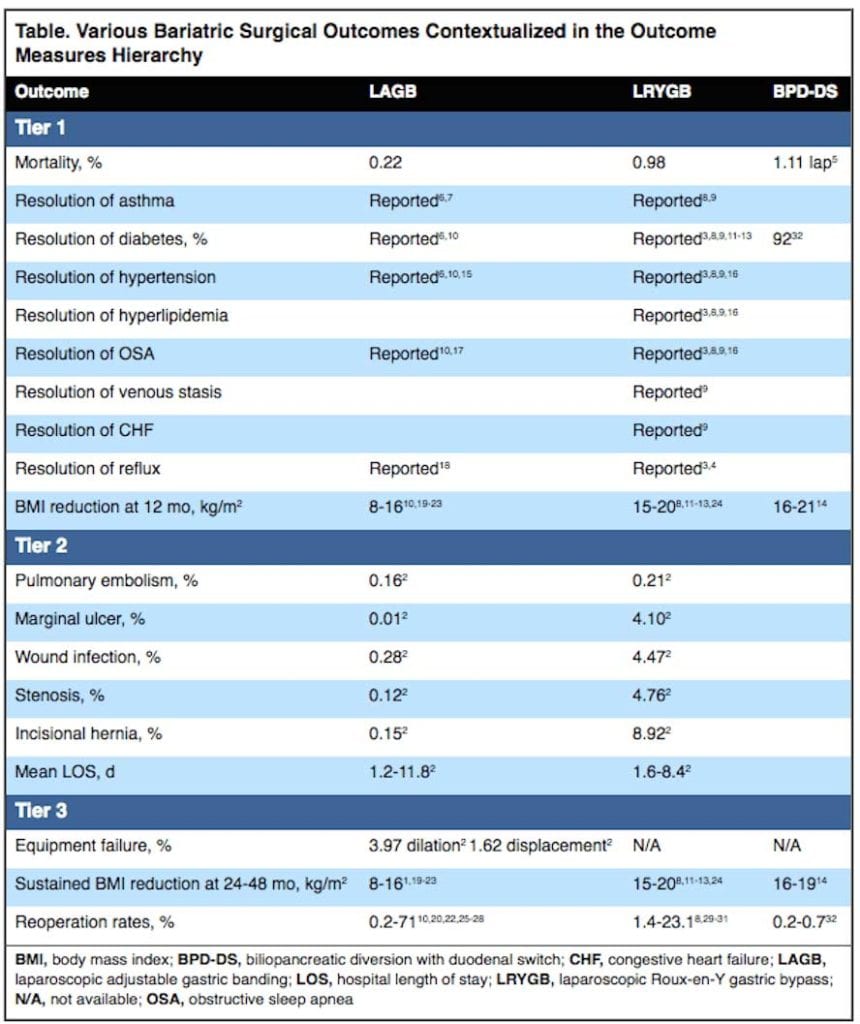
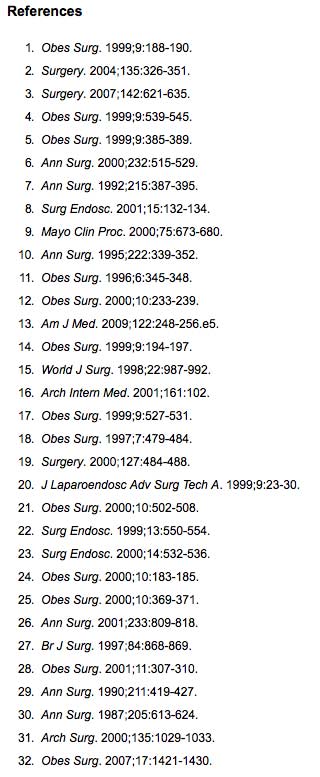
Adjustable gastric banding had the highest reported re-operation rate. To be noted is the longer the time lapse the higher the need for re-operation for the band.
Original article here.
Shared Success Story- Stephanie U.
September 22, 2015 7:38 am

When I think back as far into my childhood as I can remember my weight was always a problem. I grew up being made fun of and missed out on the simple things that normal kids do growing up because my weight caused limitations.
Even into early adulthood I was still made fun of, but I learned to deal with it. I tried different methods of trying to lose weight. I went to a gym, tried diet pills, followed diets, cut out foods, sodas, alcohol, etc. Sure these things worked (very slowly) for a period of time, but then I would plateau and became discouraged and gain whatever little weight I lost plus some. By the time I was 27yrs old I found myself at my heaviest at 245lbs and I was also pregnant with my first child. I was lucky enough to have a healthy pregnancy. However after I had my daughter, I went up to 265lbs and just couldn’t get it off. I felt the toll the weight was taking on my body. My hips would ache, go numb, my lower back would get stiff, I would become winded just walking upstairs, it was difficult to get up from sitting, my feet would be sore if I was standing too long. I began to realize this was just going to get worse as time went on and as my daughter got older parenting would become more difficult. It became an even bigger concern to be healthier now that I had a little one depending on me and looking up to me.
I decided to explore the option of surgery in late 2013. I knew it was something that my insurance would cover so long as I met the requirements so I set out to find a reputable surgeon in my area.
Surprisingly I reached out into a Facebook group and was overwhelmed with recommendations for Dr. Keshishian (I was originally interested in the DS surgery). I went for my consultation in December of 2013. Upon meeting with Dr. Keshishian I knew I wouldn’t have wanted anyone else to perform this surgery on me. He was very upfront, honest, and straightforward with information regarding what was to come and the effort that needed to be put forth in order for this to work. The Gastric Sleeve was brought up and I decided to go with the sleeve surgery. I pushed forth and the staff at Dr. K’s office began the process of approval which happened to move very swiftly and smoothly.
I ended up having my surgery on 4/11/14 and I weighed 265lbs on the day of. Today, as I write this I am, approaching my 30th birthday healthier than I think I have ever been and I currently weigh 152lbs. The adjustment post-op was not an easy one, but it was well worthwhile. I am much more active, able to keep up and play with my daughter. I feel like I am living a normal life for once. I was scared, nervous, and had so many worries running through my head prior to surgery but now that I have gone through it I would make the same decision all over again in a second’s time.

Revision of a Sleeve Gastrectomy or RNY
August 31, 2015 6:32 am
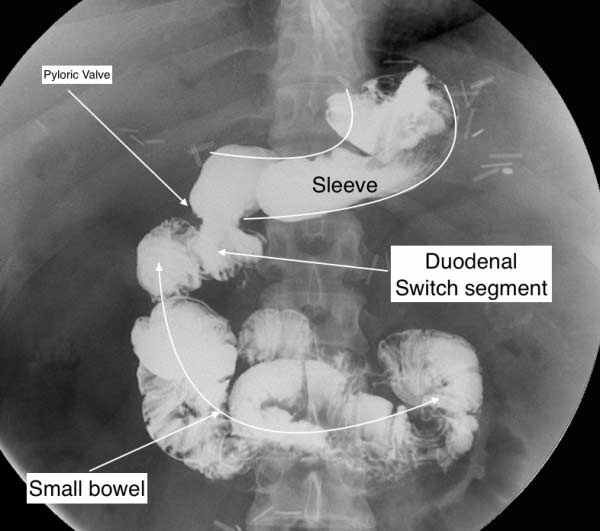
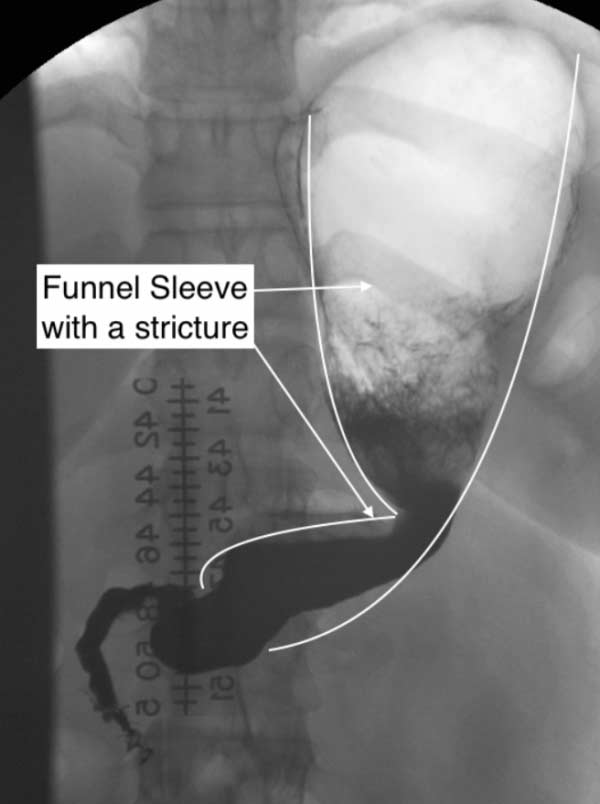
These are examples of two types of patients referred to us for revision surgery.
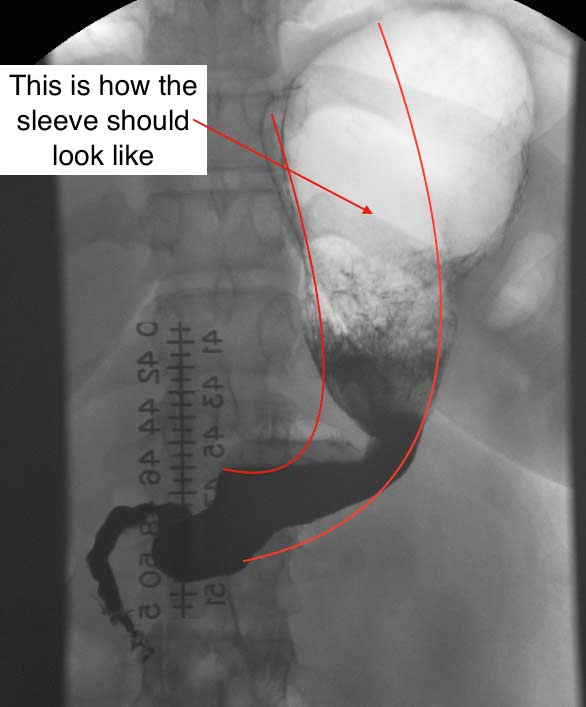
The first example is a gastric bypass that we revise to the duodenal switch operation. The upper GI series after the revision, shows a “banana shaped” stomach, the pyloric valve and the duodo-ilesotomy anatomosis component of the duodenal switch.
The second example, images noted below, is that of a sleeve revised to the duodenal switch – both operations done at different institution. Note how the stomach is not a “banana shaped” and more like a funnel with a narrowing at the bottom of the stomach- a stricture.
Internal Hernia And Bowel Obstruction
August 21, 2015 7:49 pm
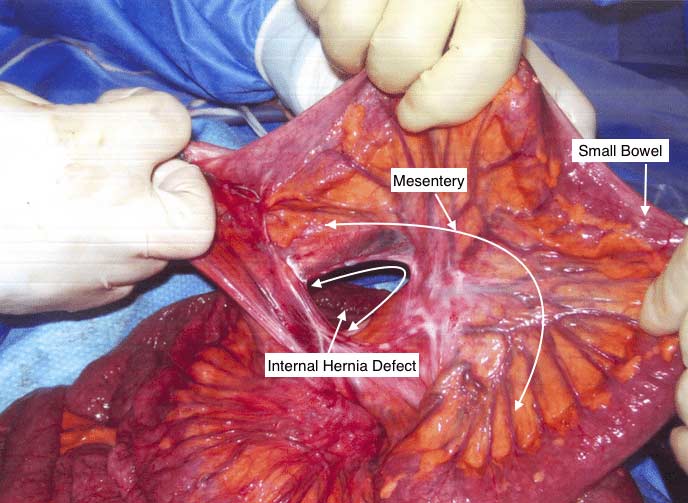
Whenever there is a bowel resection with anastomosis made there will be a defect in the mesentery (the tissue that holds the blood supply and the nerves etc going to and from the bowel) that needs to be closed. In this particular case, the stitches that were used to close the defect were intact and yet the tissue had separated from it. The result is an internal hernia. This can cause bowel obstruction, where by a loop of the bowel can go through the defect and kink the bowel causing the blockage. In some cases, the internal hernia may reduce itself with intermittent symptoms of the bowel obstruction and in other cases it may require immediate emergent surgery. A CAT scan with oral and IV contrast is needed after Duodenal Switch to visualize the alimentary and bioliopancreatic limbs.
Symptoms may include but are not limited to:
- nausea
- vomiting
- abdominal bloating
- abdominal tenderness
- cramping abdominal pain
- diarrhea, constipation
- feeling of inability to completely empty bowels
- fever
- severe abdominal pain.
Billroth I & II, SIPS, SADI, Loop
July 27, 2015 1:30 pm
In 1881, Dr. Theodore Billroth performed the first successful gastrectomy for pyloric tumor. He removed the distal part of the stomach and tumor of the pyloric region and reconnected the distal end of the transected stomach directly to the segment of the duodenum. This was later renamed as Billroth I procedure. In Billroth I the anastomosis allows the food pathway to stay in the same directional flow with the exception of pyloric valve having been removed. There is, however, increased incidence of bile reflux with the pyloric value removal.
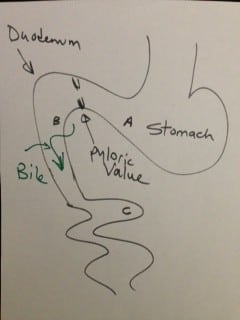
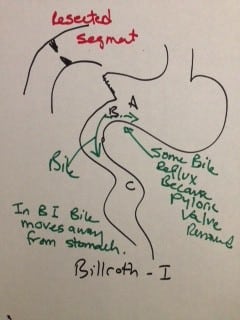
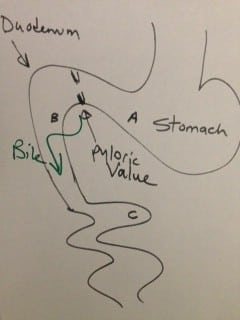
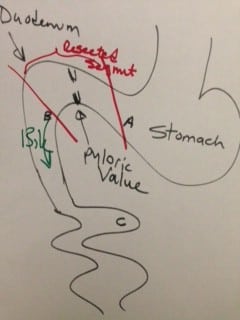
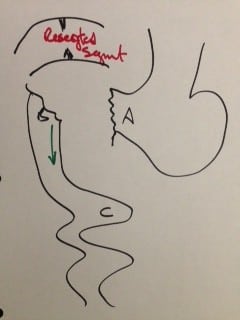
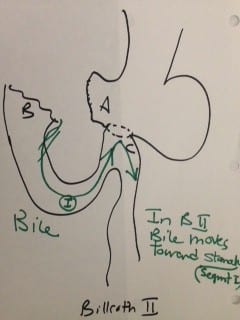
There are incidences where the resected segment is so large that the proximal stomach and the distal duodenal can not be mobilized and brought close to each other to be able to create the Billroth-I anastomosis. Larger resection, where the Billroth I could not be completed Dr. Billroth in 1885 created a procedure call the Billroth II. The Billroth II was performed when the tumor was very large and the continuity of the GI track was created by a loop gastrojejunostomy. This procedure was named Billroth II.
In the Billroth II the bile flow from the small bowel flows toward the stomach, and this results in a much higher incidence of Bile reflux and its associated complication.
The lesson learned from Billroth I and Billroth II was that bile reflux can be a significant problem when creating the continuity of the proximal GI track with exclusion of the pyloric valve. In Bilroth II, there is the additional burden of the bile flowing toward the stomach unlike the Billroth I.
The SADI or SIPS, Loop procedures that are incorrectly promoted as “duodenal switch” employ a loop anastomosis, which results in a biliary flow toward the post pyloric duodenum significantly increasing the chance and the possible incidence of Bile reflux.
All these unknowns about the SIPS, SADI Loop are yet to be investigated.
Alcohol and Weight Loss Surgery Webinar May 20, 2015
July 27, 2015 7:27 am