Duodenal Switch Look Alikes- SADI/SIPS/Loop
October 23, 2015 4:06 pm
There is no substitute for the Duodenal Switch (DS) operation. The other easier procedures that are being presented as DS equivalent are untested, and unproven operations that in my opinion will fall short of the outcome patients expect. The coding definition of BPD/DS is as follows: A Gastric restrictive procedure with partial gastrectomy, pylorus-preserving duodenoileostomy and ileoileostomy (50 to 100cm common channel) to limit absorption (biliopancreatic diversion with duodenal switch) Please not that there are two anastomosis within the definition.
As a patient advocate and a surgeon who has seen a number of recent complications (significant bile reflux gastritis, inadequate weight loss, etc..) of these “Duodenal Switch” substitute procedures, (SADI/SIPS/Loop) I would recommend that any patient considering anything other than the anatomically accurate and proven standard DS procedure realize that they are being subjected to a procedure with an unknown long-term outcome other than what is published in a few studies with a very short-term follow-up. The weight loss of SADI/SIPS/Loop studies have only been measured in terms of months versus years. I would predict that for the majority of those patients, the long-term weight loss will be inadequate and further corrective surgery will be needed, either for inadequate weight loss or other complications such as bile reflux.
Teaching Nursing Students about Duodenal Switch!
October 19, 2015 11:34 am
Dr. Keshishian explaining the different weight loss surgical procedures to nursing students. Including the duodenal switch before cases to a number of nursing students on a board in the operating room. Dr. Keshishian is always willing to educate and draw with a smile but not always with a bowtie!

Cindy Porcell, Surgical tech put the finishing touches on it.
In case you are wondering, surgical scrubs do not have bowties!
Calcium – Revisited !Exclusive Member Content
October 05, 2015 8:06 am
Surgical Outcomes
October 02, 2015 10:10 am
In a recent review article published in the September 2015- Volume 42:10 of General Surgery News, the surgical outcomes of different procedures were summarized. There were evaluated based on a number of measures, including re-operation rates. So interesting to note that the re-operation rate of the duodenal switch is the lowest of all surgical procedures.
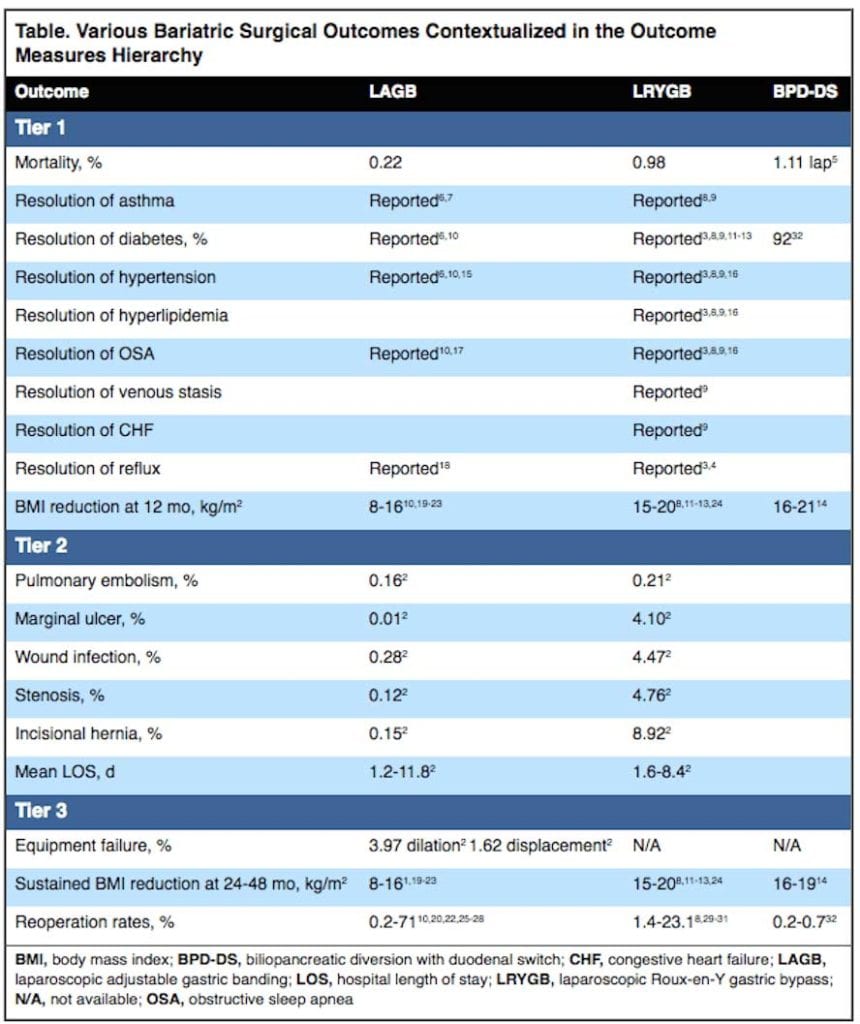
Adjustable gastric banding had the highest reported re-operation rate. To be noted is the longer the time lapse the higher the need for re-operation for the band.
Original article here.
Failure of Anti-Reflux Procedures
September 28, 2015 7:13 am
A recent study Published in JAMA Surgery, quoted rate of 10-20% of patients who have had anti-reflux surgical procedures will have recurrence of his symptoms within the research data. There are numerous studies that have identified predictive factors leading to return of the symptoms after surgical intervention. Some of these predictive factors are improper diagnosis, inadequate work up and technical issues.
Due to the significant rise of sleeve gastrectomy as well as a high failure rate of the lap band, we have seen several patients presenting with significant reflux disease after weight loss surgery. There is a little scientific data regarding the failure of anti-reflux procedures in patients who have had previous weight loss surgical operations. In our practice, however, we have extensive experience with anti-reflux operations in patient who have had previous weight loss surgeries including Gastric Bypass, Adjustable Gastric Banding, Sleeve Gastrectomy and Duodenal Switch operation.
Improper diagnosis, inadequate work up, and technical issues have been cited as possible causes for recurrence of symptoms in patients who have not had weight loss surgery. One could assume that those variables are still a factor in addition to other factors resulting from a previous weight loss surgery. The complications of a previous weight loss surgery can not be under-estimated; an example would be a patient with significant esophageal motility issues directly related to an Adjustable Gastric Band. Other situations that exacerbate symptoms of reflux are an hour glass shaped sleeve or a stricture mid stomach post Sleeve Gastrectomy or Duodenal Switch.
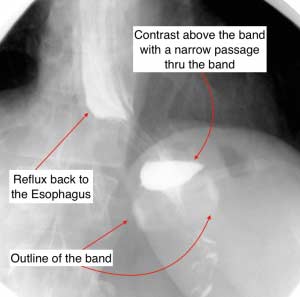
In our experience, some patients have responded well with anti-reflux surgical procedures and mesh placement if indicated after a compete work up with has included and upper endoscopy, upper GI series, manometry and Ph studies. Any patient with symptoms of reflux after weight loss surgery, should be evaluated, and a complete work up should be performed to establish the proper treatment options. It is not wise to have patients be treated with proton pump inhibitors as a default treatment without a complete work up for any patient with reflux. These class of medications have significant side effects associated with them. Furthermore, prolonged reflux is a factor in development of Barret’s Esophagus, a pre-cancerous condition.
Shared Success Story- Stephanie U.
September 22, 2015 7:38 am

When I think back as far into my childhood as I can remember my weight was always a problem. I grew up being made fun of and missed out on the simple things that normal kids do growing up because my weight caused limitations.
Even into early adulthood I was still made fun of, but I learned to deal with it. I tried different methods of trying to lose weight. I went to a gym, tried diet pills, followed diets, cut out foods, sodas, alcohol, etc. Sure these things worked (very slowly) for a period of time, but then I would plateau and became discouraged and gain whatever little weight I lost plus some. By the time I was 27yrs old I found myself at my heaviest at 245lbs and I was also pregnant with my first child. I was lucky enough to have a healthy pregnancy. However after I had my daughter, I went up to 265lbs and just couldn’t get it off. I felt the toll the weight was taking on my body. My hips would ache, go numb, my lower back would get stiff, I would become winded just walking upstairs, it was difficult to get up from sitting, my feet would be sore if I was standing too long. I began to realize this was just going to get worse as time went on and as my daughter got older parenting would become more difficult. It became an even bigger concern to be healthier now that I had a little one depending on me and looking up to me.
I decided to explore the option of surgery in late 2013. I knew it was something that my insurance would cover so long as I met the requirements so I set out to find a reputable surgeon in my area.
Surprisingly I reached out into a Facebook group and was overwhelmed with recommendations for Dr. Keshishian (I was originally interested in the DS surgery). I went for my consultation in December of 2013. Upon meeting with Dr. Keshishian I knew I wouldn’t have wanted anyone else to perform this surgery on me. He was very upfront, honest, and straightforward with information regarding what was to come and the effort that needed to be put forth in order for this to work. The Gastric Sleeve was brought up and I decided to go with the sleeve surgery. I pushed forth and the staff at Dr. K’s office began the process of approval which happened to move very swiftly and smoothly.
I ended up having my surgery on 4/11/14 and I weighed 265lbs on the day of. Today, as I write this I am, approaching my 30th birthday healthier than I think I have ever been and I currently weigh 152lbs. The adjustment post-op was not an easy one, but it was well worthwhile. I am much more active, able to keep up and play with my daughter. I feel like I am living a normal life for once. I was scared, nervous, and had so many worries running through my head prior to surgery but now that I have gone through it I would make the same decision all over again in a second’s time.

Shared Success: Kurtis R.
September 08, 2015 5:27 am
For most of my life I had always been on the heavier side of the scale. Since I was a kid I’ve been extremely active with sports and other activities that required me to be running around, but my diet wasn’t on the right track. Even with all the working out or running I did, my diet is what led me to having the body I didn’t want anymore.
I didn’t have the same troubles a lot of bigger or heavier kids had. I wasn’t picked on or depressed. I was liked by just about everyone and had a large group of friends. That part of my life has never changed. What did change was the way I looked at myself in the mirror. I never had confidence in myself when it came to most aspects of life. Sports, I had all the confidence in the world. Nobody could strike me out, or get passed me with a football. The day it really changed for me was about 3 years ago. I was sitting on my bed, about to go to the store and realized I couldn’t bend down far enough to put my socks on without sucking in, holding my breath and leaning my legs out to the side. I got on the scale and realized I had hit 410LBS. 410LBS with a BMI around 50% at 22 years old. A weight I had never thought about, but also a weight I never thought I would be. I was lazy and didn’t care about what I ate. I worked from 7-4 and then played video games until it was time to go to sleep. No exercise and a terrible diet only lead to one result, and that’s a very unhealthy body. I brought this all up to my mom (who had gastric bypass ~15 years ago) and she said if I wanted, we could look into the weight loss surgery options.


She did the work in the beginning, finding out where we needed to go and when I decided I wanted to do this, she was there with me at the group meeting where we first met Dr. Keshishian. I knew from the second I saw his bow tie that he would be a pleasure be around. He brought out pictures and described the differences, pros and cons of each different surgery, I knew Dr. Keshishian was the doctor I wanted. Originally I wanted to just have the Gastric Band, but after hearing Dr. Keshishian go through every option, I ultimately decided to have the Sleeve Gastrectomy done. This was one of the best decisions of my life.
I had the surgery done in March of 2013 (~2.5 years ago) with a starting weight of 410 LBS. Now, 2.5 years later I weigh 250LBS and have lowered my BMI to about 20%, a number that I’m focusing on now. I didn’t have the surgery to become a skinny man. I like being a bigger guy. I just want to be healthy and get my BMI to about 12-15%. With the help and motivation from my parents, friends, family and beautiful girlfriend Kori, there are no doubts in my mind that I’ll be able to reach my end goal and continue on this path of health and exercise for the rest of my life.
Revision of a Sleeve Gastrectomy or RNY
August 31, 2015 6:32 am
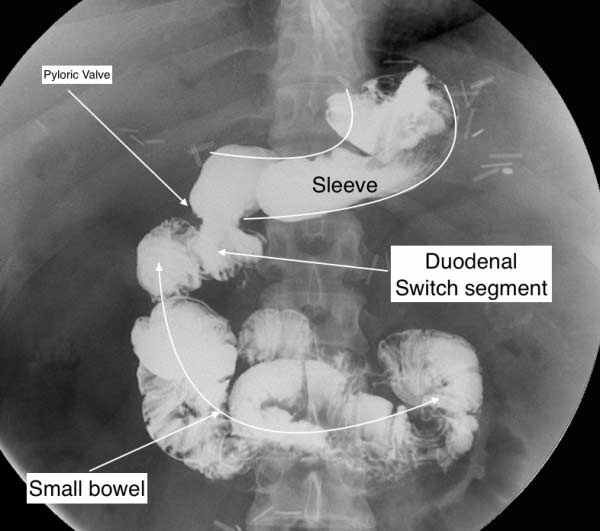
These are examples of two types of patients referred to us for revision surgery.
The first example is a gastric bypass that we revise to the duodenal switch operation. The upper GI series after the revision, shows a “banana shaped” stomach, the pyloric valve and the duodo-ilesotomy anatomosis component of the duodenal switch.
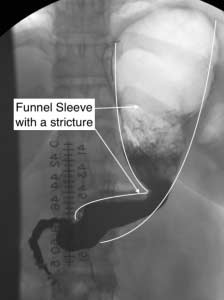
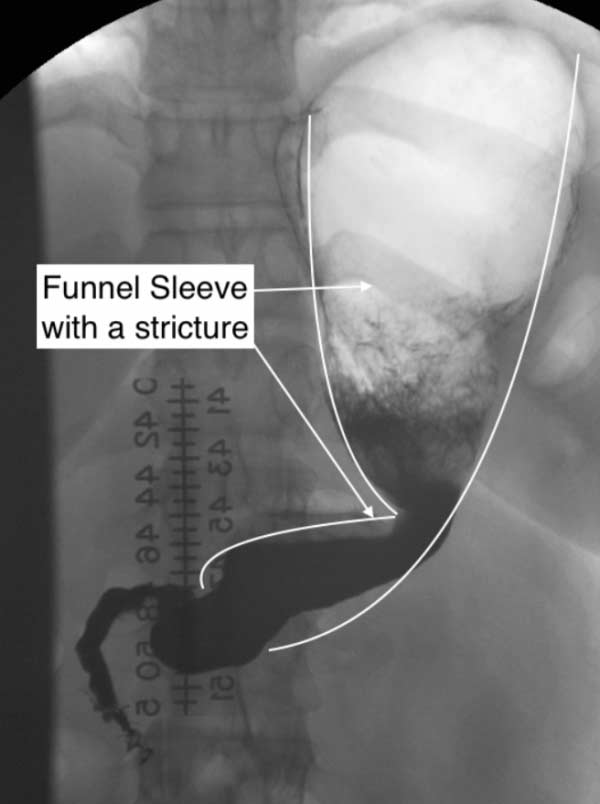
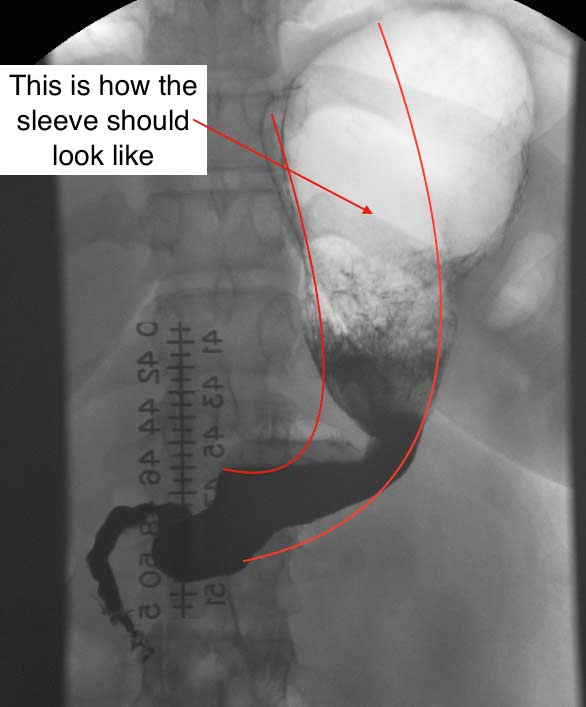
The second example, images noted below, is that of a sleeve revised to the duodenal switch – both operations done at different institution. Note how the stomach is not a “banana shaped” and more like a funnel with a narrowing at the bottom of the stomach- a stricture.
Shared Success: Kriston & Shirden
August 27, 2015 5:27 am
My wife, Kriston, and I have struggled with our weights for most of our lives. Over the years we have tried dieting, exercise, medications, and so on….with no luck. A few years ago she started to bring up the idea of weight loss surgery as a possibility. This was an idea that I was dead set against partly for fear of having major surgery and partly because it felt like cheating to me. In my mind, I believed that I should have been able to lose the weight if I really wanted to do so. Kriston continued to bring up the subject. She talked about friends who had had the surgery and how well they were doing with their weight loss. I still resisted the idea until she made the argument that if we didn’t do something about our weight then we might not live to see our daughter grow up and have children of her own someday. That was when I realized that I had to investigate the surgery and what it entailed.



We made an appointment to meet with Dr. Keshishian for an orientation and listened to him as he talked about the problems many people have with weight loss, obesity, genetics, metabolism, what surgeries were available, and the pros and cons of each of them. After meeting him and learning about the surgeries and obesity, I felt very confident that this was the man that could help us with our weight loss struggles. We decided to go with the Duodenal Switch and I scheduled my surgery for June of 2013 and Kriston scheduled hers for November of that same year. We felt this would allow me time to heal and then I would be able to help Kriston after her surgery. I won’t go in to all the details of the surgeries except to say that they both went very well. My recovery was a bit rocky, my wife will say that I was a big baby, but I did recover. I will admit that she was a much better patient than I. Fast forward two years and we are both doing very well. I have lost 180 lbs and Kriston has lost a little over 100 lbs. We look and feel great and we enjoy a much happier and active life style, we even went ocean kayaking last week which is something I could have never done at 370 lbs. This surgery has changed our lives and we could not be happier. We will be forever grateful to Dr. Keshishian, and his incredible staff, for all that they have done to help us become the healthy and happy people we are today.
Hypertrophy of Small Bowel and Weight Gain Years After Duodenal Switch
August 21, 2015 7:53 pm
Duodenal switch (DS) operation results in the highest success rate of all weight loss surgical procedures. Patients, over time, will experience some weight gain many years after DS procedure. There are a number of suspected mechanisms that may be responsible for the weight gain:
1-Ageing may slow the metabolism and the activity down.
2-Over time patients may not be as adherent to healthy dietary and lifestyle changes as they may have been immediately after surgery.
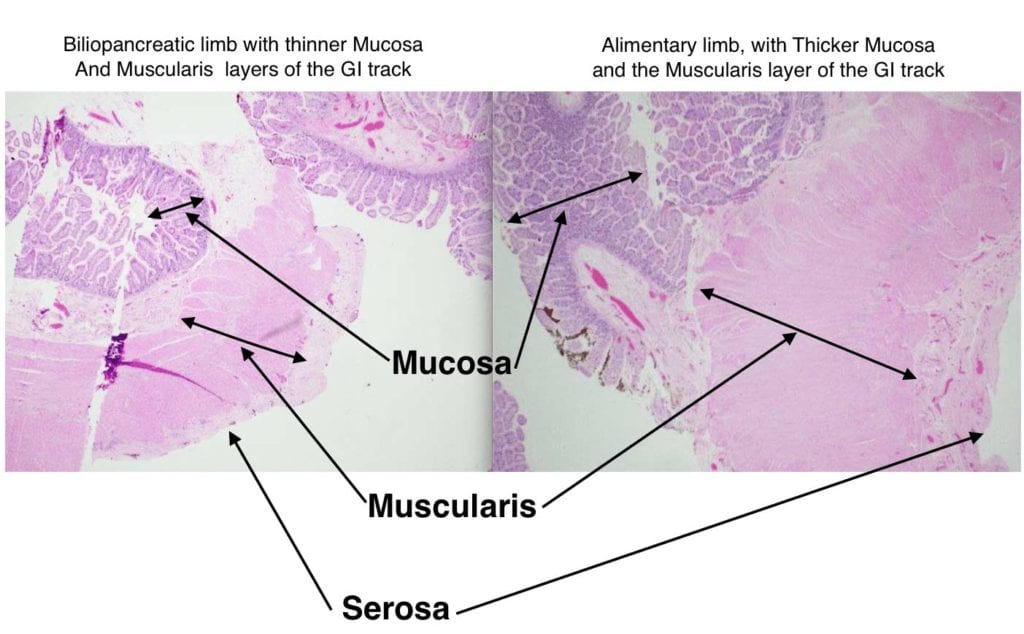
3- Hypertrophy of the alimentary and common channels over time increases in surface area f allowing greater caloric absorption leading to increased weight gain.
It has been demonstrated in bowel resection studies, as well as rat studies, that the nutrient stimulated regions of small intestine increase villus height and total weight, crypt depth and proliferation as well as wall thickness, as an adaptation to compensate for the loss of absorptive capacity in the resected bowel. This observation may be applied to DS procedure as seen in histological slides from a patient who had to have an operation done requiring bowel resection. The segment of the bowel resected included the junction of the biliopancreatic, common and alimentary limbs.