
Weight Regain
January 09, 2010 12:50 am
Jillian O.
This is my story about weight regain after Duodenal Switch. I had my DS eight years ago. At the time, not as much information about the DS post-op life was available, as there is today. It wasn’t uncommon to hear people say that they can eat everything they want without consequences. That may be true for some, but not all. The DS isn’t a free ride for everyone and weight regain is possible. This is my story of how I regained weight and what I’ve done about it. I started at 406 lbs. At the time I had my DS, there weren’t many surgeons performing it, so I had to travel out of state to get it done. The instruction I was given after surgery was simple, eat at least 80 grams of protein a day and make sure to eat it first. Anything else afterward that fits in your stomach is ok. The assumption being that after protein, you wouldn’t have much room for other foods. I became very active once I started to lose weight. I always enjoyed being active when I was younger so I started to run and lift weights five times a week. I think that really helped with my weight loss. At my lowest I was around 240lbs., which might seem high, but I actually looked really good at that weight. I am 5’10 and have very dense bones along with a lot of muscle mass – from working out. A few years later I had some plastic surgery procedures and loss a lot of blood making me anemic. It took six months of trial and error then going to a hematologist before I got a series of iron infusions. During these six months, I got very tired. I stopped working out and was so out of it that I would fall asleep at my desk. I basically worked and slept, that was it. I eventually had a weight regain of 20 lbs. I should have contacted my surgeon’s office or asked for advice on the DS board, but I didn’t. That probably would have resulted in getting the iron infusions a lot quicker. Lesson learned! At another point during the last eight years, I developed a bad case of IBS due to some external stresses in my life. I was in a lot of pain and discomfort all the time. I went to a specialist and had a colonoscopy and was told that it was IBS then I was given a diet to follow that would stop irritating my digestive system. I was so miserable that I would have done anything to feel better. So, I followed the diet that was very anti-protein and pro-carbs. If you google recommended diets for IBS, you will see what I mean. I gained back more weight from the diet and from lack of exercise due to being in pain. Once I eliminated the external stresses and followed the diet for a while, I eventually got better and the IBS went away completely. I think the fact that I entered into therapy helped a great deal as well. Last winter, I suffered a fall down some concrete steps. I slipped on some ice I didn’t see and landed at the bottom step on my arm and shoulder. I ended up shattering my right from the shoulder almost to my elbow and was immobilized for three months, then in intensive physical therapy for six months. During this time, I couldn’t do anything for myself. I sat at home; my friends and family brought me food and goodies, which I ate. I also gained more weight. So, over the course of 8 years and the three incidents I mentioned above, I had a weight regain of 50 lbs. I got way off track from how I should be eating and was just really disconnected from my body and all things DS. I knew I needed to make some changes to turn things around. I got back on the Obesity Help DS Forum and started asking questions. I found out how well informed everyone is about the DS now and got myself back on track. I started by tracking my daily food intake in fitday.com. Boy, was that eye opening! I realized and saw for myself just how upside down my protein and carb intake were. I didn’t change my eating habits right away, I kept tracking in fitday.com and started to read the daily food & fitness threads on the DS Forum to get an idea of how others were eating as well as getting food suggestions. After a couple of weeks, I started to cut way back on the carbs and add more protein into my daily diet. I started this process mid May 2008 and by June, I had made major shifts in how I was eating. I should also mention that I had been exercising regularly all along when I could. I started with solitary exercises like running on a treadmill and lifting weights. Later, I found a Pilates instructor and started taking equipment and mat classes. Pilates is something that I’ve come to love and started doing 4-5 times a week. I then added Zumba into the mix and got to the point where I was working out 8-9 hours per week and loving every minute of it. I think finding something that you love and something that doesn’t feel like work is the key. I’ve enjoyed getting more in tune with my body and spending time with the women in my classes. The result of the changes to my eating habits and the increased exercise has helped me lose all the weight I regained plus a few more, 55 lbs. in total. I am back in my skinny jeans and having to buy new clothes. I indulge occasionally and find that as long as I don’t indulge more often than I do, I am ok. Moderation is key. I still enjoy chocolate and goodies when craving them, but they aren’t daily staples anymore. In the course of the past six to seven months, I have got back to the basics with my eating, but I don’t feel deprived. I’ve increased my exercise, which I enjoy and have exceeded my original goal. Life is good!! The DS is fantastic!! It’s still working for me after all these years! Here are the DS basics as prescribed to me by the members of the DS Forum and what I’ve been following:- I eat 80-100 grams of protein per day
- I keep carbs at 50 grams or less per day
- I try to keep the carbs I do eat complex and only rarely eat simple carbs
- I drink at least 64 oz. of water or SF liquids every day
- I don’t worry about fat or number of calories
- I track my food on fitday.com every day
Denise
I’m 6 ft. tall and was 377 lbs. on the day of surgery. I was 50 years old and didn’t really set a specific goal, but being below 200 lbs. would have been nice. I lost 130 lbs. in the first year and a half, and if I stopped right there, I would have been happy. Not skinny, by any means, but I just wanted to feel lively and be active again which I did. At about 2.5 years out, I stopped focusing on protein and had a pretty steady diet of carbs and sweets. Cruelly, I never focused on sweets before the DS, but for some strange reason, I developed an unbelievable sweet tooth post op; I was always a salty/crunchy kind of person. Many post-op DS patients find it difficult to eat too many sweets, but not me. I never feel full when I’m eating sugary treats. I used to weigh myself daily, which helped me stay on track (that doesn’t work for everyone, but it’s a necessity for me). I totally lost control and gained 70 pounds in the next year. I hit 311 lbs. earlier this year. I’ve always been good about my vitamins and water, so my blood work has been fine. I have avoided beating myself up and also avoided considering myself a total failure at the DS. I simply fell back into old habits of letting my weight put up a wall to protect me from things I wanted to avoid in day to day life. Earlier this year, after addressing a few non-DS and non weight related health issues, I realized that I want to feel good again, just like I did a few years ago. I started around April of this year and here is how I got back on track: 1. I cut my carbs back to below 50. 2. I weigh myself daily. Beware, if you can’t be okay with daily fluctuations, this may not be a good thing for you to do. 3. For a few months, I tracked my food on the Daily Plate. Once I got back on track, I stopped the daily record, but will return to it if I feel out of control. Getting in over 100 grams of protein is easy for me; it’s keeping the carbs low that was more difficult. 4. I’ve cut out all major sugar for now. I’m sure I’ll be able to re-introduce sugary treats back into my lifestyle someday, but just not now. 5. I’ve continued to see a counselor because food has always been my coping and self-comforting mechanism, which I have to work on that daily. 6. I also refocused on how blessed I have been that I was able to have the DS after canceling my appt. for an RNY when I heard about this option. My insurance approved me in a matter of days. I also had incredible friends who traveled for 2 hours, took time off work to take turns and come and stay with me at a hotel for one week after I was released from the hospital. (I had my surgery in Dayton, but live in Columbus). Bottom line, I’ve now re-lost 38 of the regained 70 lbs. I am back on track and feeling great. I’ve started walking again, which I still hate doing, but I’m doing it. The DS continues to work. I may not be losing as fast as 4 years ago, but it’s still coming off faster than a non-WLS person. Yes, you can regain some weight on the DS if you stop eating protein first and slip back to poor dietary choices that will cause weight gain in everyone. I love not having to worry about fat. I do love DS and I’m thankful it continues to work, even 4 years later! As I said at the beginning, I’d do it all again in a heartbeat.Duodenal Switch and Distal Gastric Bypass (ERNY)
December 04, 2009 7:24 pm
On 10/28/2009 I had a variation of the RNY gastric bypass (Distal Gastric Bypass) known as the Fobi pouch. I lost over 270 pounds, but I had debilitating complications of dumping syndrome, reactive hypoglycemia, acid reflux and vomiting.
My entire day was pretty much controlled by dumping syndrome. Due to the hypoglycemic episodes that resulted from dumping syndrome, I was constantly in a binge cycle, because I constantly needed to stabilize my blood sugar. I would eat breakfast and need to lay down. Once I started having hypoglycemia, I would get up and splurge on carbohydrates.
Note that my dumping syndrome was not caused by poor food choices. I only splurged off carbohydrates in a desperate attempt to quickly get my glucose levels up. This did work, but it lead me to dumping syndrome again. I then had another episode of hypoglycemia, which lead to more binging which resulted in more dumping, more binging and weight gain. Here is a diagram of the cycle I was constantly in:
Eat –> dump –>hypoglycemia –> binge –>redump –> more hypoglycemia –> binge –> dump
This was a constant cycle I was in, and as you can see here, my entire life became controlled by dumping syndrome, and it eventually caused me to become disabled. I am a full time student and was not able to go to school in this state. I would eat lunch and then go to class only to start dumping ten minutes into lecture, and I ended up dropping my classes for the semester.
I went to my bypass surgeon and told him of the problems I was having, and he told me that I was anorexic. I was also told that it was “…all in my head.”
After doing much research, I consulted with Dr. Keshishian. I handed him a list with the problems I was having and asked if revision to the duodenal switch would resolve these problems. Dr. Keshishian drew out a diagram of the anatomy of my surgery and showed me exactly why I was having these complications. I remember him saying, “There is a physiological explanation for why you are having these problems. It is not in your head. Yes, revision will resolve these complications.”
I had my revision on 4/11/2011, and all the complications I had with my bypass have been resolved, and I have had no complications with my duodenal switch. Now that my pylorus is working again, I can eat without becoming ill. I have now gone back to school, work, and have resumed back to a normal life.
YG
John C
November 28, 2009 12:51 pm
John’s Stats
DS Veteran: John C.
Location: MI, USA
Surgery Date: June 20, 2008
Surgeon: Marek Lutrzykowski, MD
Highest Weight: 502 lbs
Pre-op BMI: 87.5
Pre-op Weight: 423 lbs
Goal Weight: 197 lbs (pre-plastics)
Current BMI: 33.8 (pre-plastics)
Current Weight: 197 lbs

Obesityhelp.com revision Forum information
November 08, 2009 9:00 am
I am not sure what has happened over the past two weeks or so, but I have received a number of inquiries from patients who have had questions about the revision of RNY or Lap Band® for weight regain, inadequate weight loss, or other complications. I finally had to ask one of the patients where he got his information and heard about our practice. His source of information was the obesityhelp.com website.
I have spent some time looking over and responding to several postings on the forum sites. I have referred to a number of publications in some of my postings on obsityhelp.com.
Nishie et.al. (Obesity Surgery, 17, 2007 1183-1188) reported:
“Pouch size area, measured by routine UGI on the first postoperative day does not influence short term postoperative weight loss. “
Cottam et.al. (Obesity Surgery 2009, 19:13-17) concluded:
“The level of restriction or the presence of stenosis achieved by different stapler sizes does not have a significant role in weight loss.”
O’Connor et.al. (Surgery for Obesity and Related Dis. 4(2008) 399-403) summarizes:
“With construction of divided, vertical, lesser curvature based small-volume (less than or equal to 20 cm gastric pouches, the actual size of the gastric pouch did not correlate with the %EWL at 1 year laparoscopic GB.”
I am a firm believer that the best patient is the most knowledgeable patient. It is always safer to spend as much time as needed to ask questions and investigate all options. If I can provide any information, please contact us at [email protected]
Length of Small Bowel
October 26, 2009 2:49 am
It appears that there are series of questions and concerns that are not completely resolved, and they resurface every so frequently. Length of the small bowel for the Common Channel and the Alimentary limb in the Duodenal Switch operation is one of those topics.
The Questions that I am asked:
- How long is my common Channel?
- Another patient had the same length, but they are loosing more (or less) as the case may be.
- I was told by another surgeon that they would give me a certain length of common channel, what do you think?
The common problem is that there is no accurate and practical way to measure the length of the bowel. There is also two schools of though, with very little objective research to support one or the other. There is no published data that I could find that answers this question head on. There are number of other
articles, and presentations that touch on this topic.
The best reference that I think is worth looking over is an editorial by Dr. Hess. The link is provided below.
I would like to discuss this in an organized way.
The artistic work is done by yours truly!
First a Brief over view of our GI track:
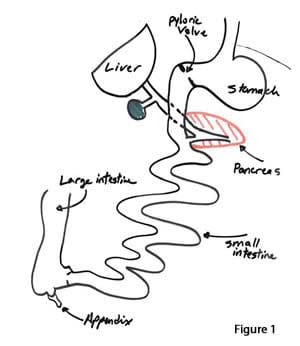
Our GI track starts at the mouth and ends in the rectum (figure 1). It is a long tube that has a very few side branches. These include the opening of the salivary glands in the mouth, the opening of the biliary (from the liver) and the pancreatic (from the pancreas) plumbing to in the first part of the small bowel
(duodenum) and the Appendix (at the junction of the small bowel and the large bowel).
Related article is available on our site.
The small bowel is the part that causes all this confusion. The small bowel is a long pliable, elastic tube that can be stretched (figure 2).
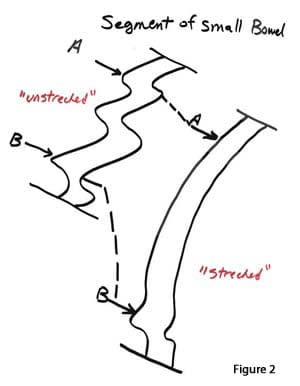
Depending on how much force is applied to it, it can be of different lengths. A similar analogy is the phone cord to head set of a conventional phone. The spiral cord placed on a table will coil up to a certain length. If one then pulls on two ends it will measure longer. And if more pull is exerted, then it will easure even longer. This demonstrates that the absolute measured length of the small bowel, is directly related to the force with which it is pulled. What this means is that if two individuals measure the length of the headset cord, or the bowel, they will get two different lengths, both correct but not the same. The length is directly proportional to the pull force applied to both ends.
Furthermore; the length of the small bowel is determinant of the absorptive capacity (amongst other factors). The longer the small bowel the more absorption, and the shorter the small bowel, the less absorption. There is a general-trauma surgical problem knows as short gut syndrome, where the length of the bowel is so short that it cannot support maintenance of the electrolytes and minerals, in additions to the required absorption of the calories. Short gut syndrome is a very difficult surgical problem to solve.
Getting back to our discussion however, we can now appreciate how two
surgeons can measure the same amount of small bowel (the same absorptive capacity) but end of with different lengths of small bowel. Same amount of bowel, same absorptive capacity, different lengths. This is why comparing lengths of small bowel is probably not the most accurate way to. Two patients, both with 75 cm common channels may have very different absorptive capacity, unless the bowel was measured by the same surgeon, and both patients had the same amount of total bowel length. We should next consider a possible alternative. Consider the drawing on (figure 3) and (figure 4).
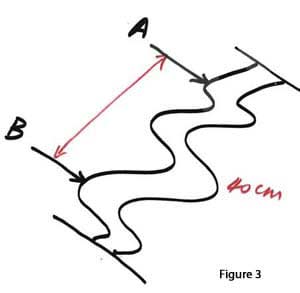
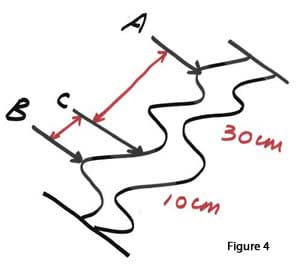
The distance between C and B is 25% (quarter) of the total length between A and B. This represents a segment of bowel that was measured and marked Now lets take the same amount of bowel and apply a little more pull force to the ends while measuring it. We will have a total length of 80 cm, between A and B (figure 5). The distance between A and C will be 60 cm and the distance between C and B will be 40 cm (figure 6). The absolute lengths then are double of the first case. Same amount of bowel, same absorptive capacity yet double the length. Does this mean that the second patient with distance between C and B at 20 cm will absorb twice as much as the first patient? The answer is no, since it was the same amount of bowel that was measured with different technique.
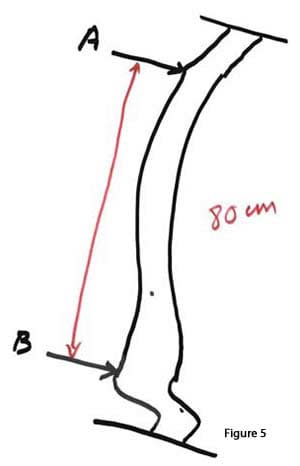
Lets now however look at this from another perspective. In both cases the distance between C and B was only 25% of the total length.
| Distances | Figures 3 & 4 | Figures 5 & 6 |
| Total length A-B | 40 cm | 80 cm |
| A-C | 30 cm | 60 cm |
| % of total | 25% | 25% |
The table above shows why lengths of bowel discussed in-terms of percentage of total may be a more standardized than the absolute numbers.
In this example both patient will have same absorptive capacity (25%) yet will have much longer absolute lengths. In our practice, we measure the total length and the common channel and the alimentary lengths are based on the patient BMI, comorbidities, age, sex, and activity level.
Please remember that this is only my opinion, different surgeons do it differently.
Bowel Obstruction From “scar” Tissue
October 12, 2009 7:52 pm
One of the potential complications of any abdominal surgery is bowel obstruction. This can occur with open or laparoscopic operation. It can also occur within days or years of the operation. The over all incidence of bowel obstruction is relatively low.
The text book diagnostic criteria for bowel obstruction is the presence of a set of physical findings additional to the diagnostic supporting evidence. A typical patient may present with cramping abdominal pain, nausea, vomiting, absence of any flatus, and not bowel movements. The pain may be dull and could be any where on the abdomen. The White count may be elevated, and a plain abdominal Xray may show “airfluid” levels. All of these finding point to a patient that has bowel obstruction. Depending on the age and the history of the patient, the a common cause may he adhesions (scar tissue) that has cause a blockage of the bowel.
Unfortunately, these physical and radiological findings may not all be present in patients that have had the Duodenal Switch or the Gastric Bypass operation. The patients may complain of nausea but no vomiting. They may still pass gas and have bowel movements, but have cramping abdominal pain. The plain abdominal xray may not show air-fluid levels, yet have complete obstruction. The presence or lack of these findings can be explained.
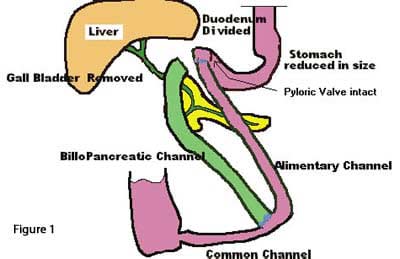
In both the DS and the RNY operations, there are two parallel limbs (figure 1). One of them is connected to the esophagus, thus it can have air in it. The other limb is not connected to the outside on the proximal end (green limb in figure one only drain the bilio-pancreatic secretions and is not connected on the proximal end to the esophagus). This major anatomical difference explains why there may be air fluid level in a bowel obstruction patient with no DS or RNY, and no such finding in a DS or RNY patient.
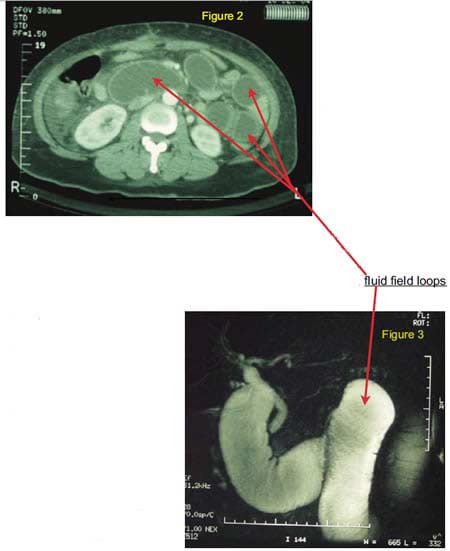
The most important diagnostic tool is a very high degree of clinical suspicion. The absence of vomiting, or air fluid levels on an abdominal xray, or the presence of flatus and bowel movements does NOT rule out a complete bowel obstruction. The more reliable way to diagnose a bowel obstruction after DS or RNY is by CT scan or and MRI (figure 2, 3).
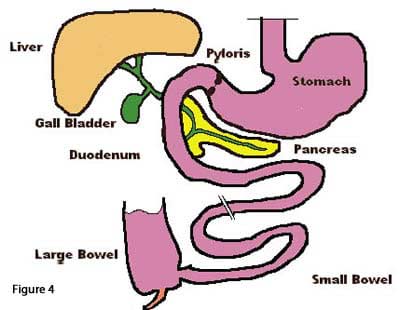
A finding of fluid field loops of bowel is highly specific for bowel obstruction and warrants a surgical intervention since it can not be corrected by a naso-gastric tube (tube inserted thru the nose into the stomach to decompress the stomach and the proximal small bowel). This is because as mentioned earlier, there is a parallel segment of bowel that is not in continuum with the esophagus. In pre DS or RNY anatomy, the entire GI track is a long tube (figure 4).
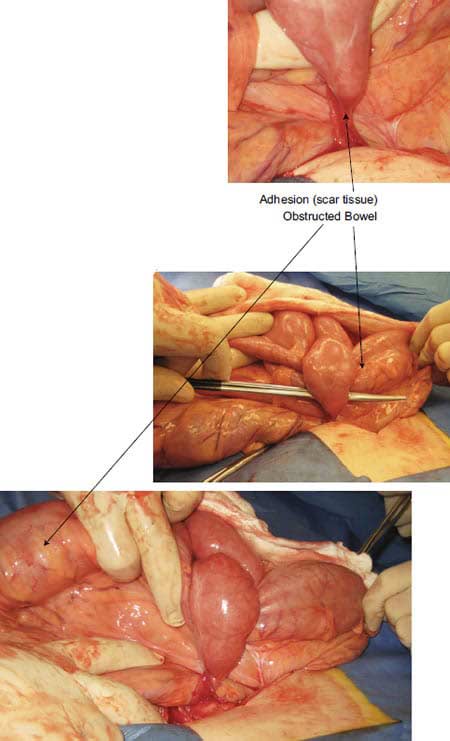
An example of a bowel obstruction caused by scar tissue is noted in the following pictures.
Does Size Matter
September 28, 2009 12:14 pm
The scientific basis for weight loss surgery, for the majority of the part relies on the premise that overeating and lack of exercise are the principal mechanisms contributing to the increase in the incidence of obesity over that last decade. Much has been said about our unhealthy life style that involves sedentary activity and immobility. Fast foods, high fat content meals, calorie dense food, are some of the examples of possible contributing factors to this health crisis.
The contrary position would be that there are other factors that contribute to obesity. These may include environmental factors, food preservatives, genetics, and exposures to toxins.
If one assumes that the over eating is the core problem, then you can also assume that the most successful operation will have the smallest stomach, since it will reduce the ability to over eat most drastically. This is where the scientific evidence does not support the theory and we all have to reassess the principal that the treatments are directed toward.
Recently there have been a number of studies that have been published in scientific journals that suggest size of the stomach or the pouch does not matter. So if obesity is the result of over eating then the operation that provides the smallest stomach must work the best. This argument should be true for the pouch size after gastric bypass, and the opening of the gastro-jejunostomy (connection between the stomach pouch and the small bowel connected to it after the gastric bypass, RNY operation). The same theory applies to the sleeve gastrectomy of the duodenal switch operation.
This argument that over eating and lack of exercise is the major contributing factor seems to be loosing ground.
The studies below are outline to demonstrate the disparity between the theory and the lack of scientific support for it.
1- Sanchez-Pernaute et.al. (Obesity Surgery, 17, 2007) reported that “After DS, gastric tube volume is not directly related to weight changes.” He proposed that there are other factors that may contribute to the weight loss than the size of the gastric tube.
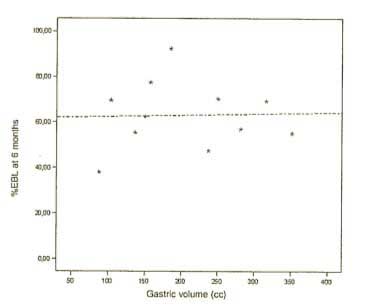
This graph taken from the referenced study above shows that the size of the stomach sleeve does not correlate with the %EBWL in DS patients. The smaller stomach sleeve does not result in the more weight loss.
2- O’Connor et.al. (SOARD 4(2008)399-403) reported that “With construction of divided, vertical, lesser curve-based small-volume (=<20cm3) gastric pouches, the actual size of the gastric pouch did not correlate wit the %EBWL at 1 year after Laparoscopic, GB [gastric bypass]”.
3- Nishie et.al. (Obesity surgery, 17, 2007) concluded that “pouch size area, measured by routine UGI [upper GI series] on the first post operative day, does no influence short-term postoperative weight loss”.
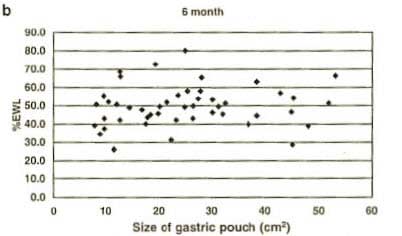
This a sample of a number of graph that Nishie published in her study. The similar graphs were for 3, 12, and 24 months. They all had a flat line distributions. What they are showed was regardless of the time lapsed from surgery, the %EBWL was independent of the size of the pouch measured immediately post operatively.
4- Cottam et.al. (Obesity Surgery, 2009, 19:13-17) reported “The level of restriction or the presence of stenosis achieved by different circular stapler sizes does not have a significant role in weight loss”.
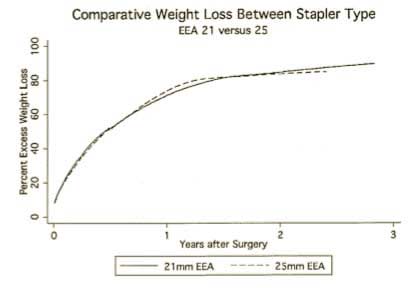
This study was focused on the size of the opening that is made between the stomach pouch and the small bowel in the gastric bypass (RNY) operation. The weight loss did not differ in the two groups of the patients. One group had a 21mm stapler and the other one 25mm stapler used. The weight loss, as measured by %EBWL was nearly identical in both cases.
In summary, the size does not seem to matter. The size of the stomach pouch, when it gets to a certain size in not important. The smaller stomach pouch or the narrower connection of the stomach and the small bowel will not make a patient loose more weight. Doesn’t this prove, to at least some degree, that there is much more to obesity than the simple notion of eating small portion and exercising?
Get informed
September 26, 2009 6:56 pm
Weight loss information
September 22, 2009 4:22 am
What is Strontium – What are BiphosphonatesExclusive Member Content
September 21, 2009 9:07 pm