
Tag: BPD/DS
Neuromuscular Disease After Weight Loss Surgery
June 08, 2015 11:30 am
Weight loss surgical procedures may result in varying degrees of nutritional deficiencies. Some of these nutritional deficiencies may cause neuromuscular disease if left untreated, these include vitamins, minerals, and protein. The long-term effect of these deficiencies may presents as neuromuscular conditions including, weakness, numbness, confusion and all others if not-diagnosed and untreated. It is important to note that all weight loss surgical procedures require lifetime vitamin, mineral supplements and protein monitoring and possible supplements.
The table below outlines some of the specific neurological and neuromuscular disease complications following bariatric surgery. The most common deficiencies seen with the duodenal switch operation are fat soluble vitamin deficiencies. These include, Vitamin A, D, E and K. Duodenal Switch patients need oral supplements of Dry “Water Miscible” type of Vitamin A, D, E, and K based on their laboratory studies and needs.
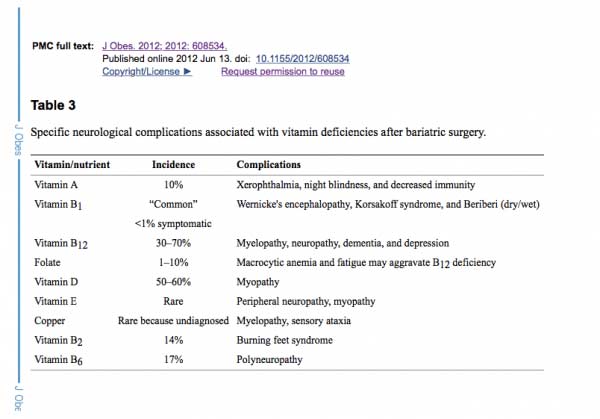
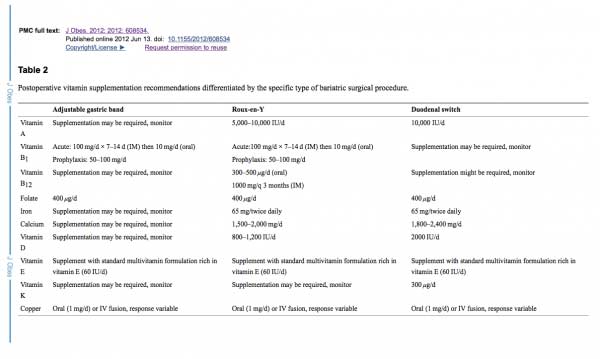
The neurological deficiencies are manifested much more frequently with the Gastric Bypass than the duodenal switch operation. The most common nutritional deficients are that of B1, B12, Folate deficiencies that are common in Gastric Bypass. A list of possible neurologic deficiencies and there associated symptoms were summarized by Becker (2012). Another article with Nutritional Neuropathies.
Nutritional deficiencies are seen in a number of illnesses including weight loss surgery patients.
Coping Skills after Bariatric Surgery
June 02, 2015 7:23 am
For many people, food can become a coping mechanism and a way to self sooth or comfort themselves. After weight loss surgery the ability to use food in this manner is disrupted due to the smaller portions and in some cases food intolerances. Developing alternative and healthy coping skills is an imperative step after weigh loss surgery.
Obesity is a multifactorial process that has many contributing aspects. Although, obesity is not entirely the result of poor eating behavior, and lack of exercise. After weight loss surgery, we should appreciate the importance of healthy dietary choices; being sure that volume and frequency is not driven by emotion or emotional eating.
The mental aspect of weight loss surgery should not be ignored. Developing healthy coping skills can be a large part of dealing with the changes that take place. Some people go through a mourning period for the loss of the foods that once gave them comfort, made them part of a group, or the feeling of their best friend. In some cases, there may be a need to seek the assistance of a mental health care provider to be able to work through some of the issues and feelings. Never hesitate or be afraid of contact a mental health care professional.
Learning and practicing effective coping/soothing techniques can be started prior to weight loss surgery. The following are some coping skills that can be effective for some to adopt into their daily lives.


1. Nature – Get out into the great outdoors and into the sunlight. The sounds and sights of nature have a way of energizing the body and calming the mind. Sunlight is excellent for increasing Vitamin D levels which can help elevate mood and general well being.
2. Exercise – The mental and physical effects of exercise are paramount after weight loss surgery. The natural chemical release from exercise is a calming effect and gives a sense of well-being. In addition, the physical aspects of increase weight loss and change in body contour have positive mental and emotional effects.
3. Music- There are many research articles regarding the positive effects on both metal and physical aspects of music. Music has a way of soothing or energizing the soul. Turn up loud or keep it soft. Sing along. Dance it out if you need to.
4. Journaling – We always suggest to people prior to weight loss surgery to start journaling. It can give you perspective when you look back at entries. We also suggest to journal body measurements, pictures, and weights so that you might look back at how far you’ve come from your starting point.
5. Mindfulness – Using all five sense to experience life and food. Take your time to take everything in and experience the full effect. Be present in all life experiences. Ask yourself: Am I enjoying this? Does this feel like what I need? Is this getting me to where I want to be? Is this healthy for me?
6. Support groups of peers- There is nothing like having a group of people who have been there or know exactly how you may be feeling to be able to talk, share or vent. There are so many support groups that can be taken advantage of in either face to face or cyber groups.
7. Treat yourself- Treat yourself and practice self-care by doing something that you find relaxing, gratifying or energizing. Massage, manicure, an outfit, shoes, an outing, or a class.
8. Distraction- Hobbies, new skills, reading, games, bubble bath, or anything that get you out of the same mental spot can help with calming and soothing.
9. Talking- There is great value in having a close friend or trusted therapist to be a sounding board and give you an opportunity to unload some of the challenges you’ve been carrying.
Changing habits and coping skills takes practice and patience. It is not something that is easily changed over night. Focus on small steps, goals and achievements. Give yourself time and credit for the accomplishments that you’ve made. Always look at how far you have come and the positive lifestyle changes you’ve made. There may be set backs but don’t beat yourself up about it, move on and continue to take steps toward your goal.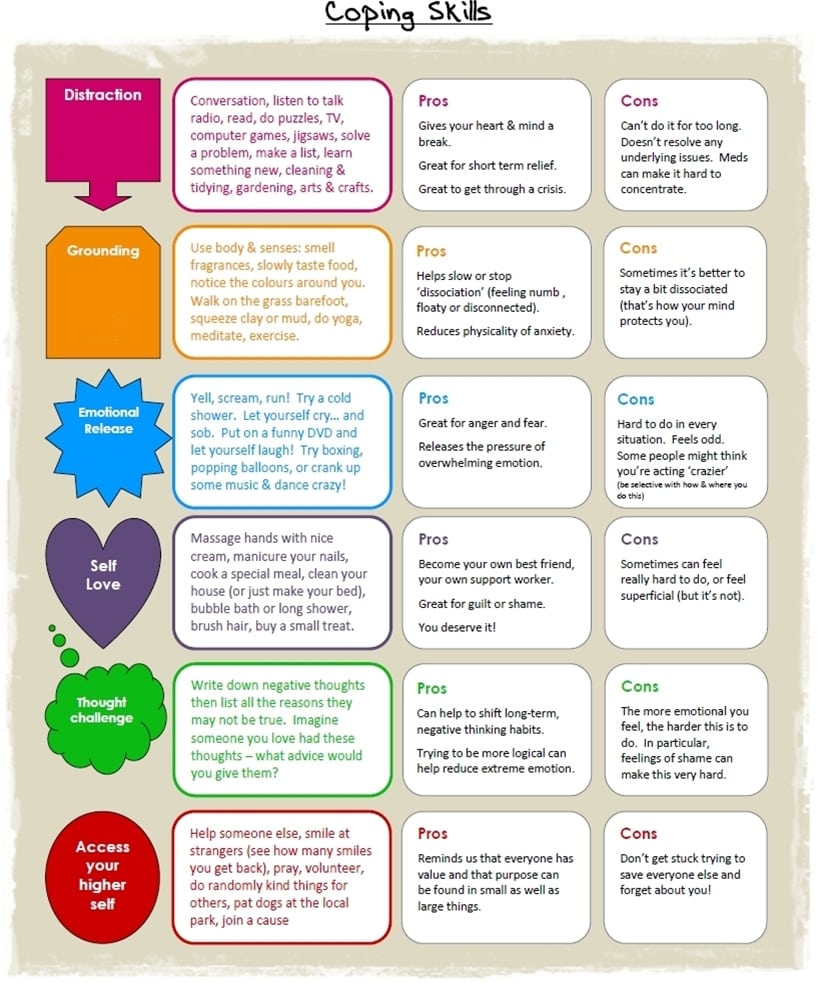
https://www.counselorlady.com
Vitamin D And A -Dry (Water soluble) Formulary
August 24, 2013 7:57 pm
Vitamin A and D are fat soluble vitamins. This means that in order for them to be absorbed by the GI track, them need to be absorbed by fat globules (chylomicrons). These are then taken up by the lymphatics of the GI track and taken to the blood stream. With the anatomical changes of the Duodenal Switch, the fat absorption capacity is significantly reduced. This results in excellent weight loss. It also results in much diminished absorption of the Fat soluble vitamins A, D, E and K. It is essential to use Dry Water Soluble forms of Vitamins A, D, E, and K. Bio-Tech is a brand that is formulated in this manner.
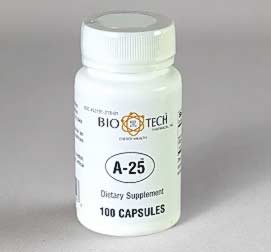
The Biotech D3-50 has 50,000IU of Vitamin D.

We recommend specific dosages of dry (water soluble) Vitamin A and D. These are not available at most pharmacies. In fact when our recommendations are presented at most pharmacies they are incorrectly dispensed with the fat soluble variety with is worth less becasue it is not absorbed by the duodenal switch patients. It is also important to not that this type of vitamin should not be taken with any dietary fat. Fat can inhibit the absorption of this type of vitamin. When ordering online, please make sure that the “Dry” or “Water Soluble” formulary is ordered.

Length of Small Bowel
October 26, 2009 2:49 am
It appears that there are series of questions and concerns that are not completely resolved, and they resurface every so frequently. Length of the small bowel for the Common Channel and the Alimentary limb in the Duodenal Switch operation is one of those topics.
The Questions that I am asked:
- How long is my common Channel?
- Another patient had the same length, but they are loosing more (or less) as the case may be.
- I was told by another surgeon that they would give me a certain length of common channel, what do you think?
The common problem is that there is no accurate and practical way to measure the length of the bowel. There is also two schools of though, with very little objective research to support one or the other. There is no published data that I could find that answers this question head on. There are number of other
articles, and presentations that touch on this topic.
The best reference that I think is worth looking over is an editorial by Dr. Hess. The link is provided below.
I would like to discuss this in an organized way.
The artistic work is done by yours truly!
First a Brief over view of our GI track:
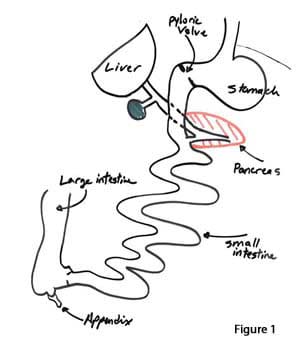
Our GI track starts at the mouth and ends in the rectum (figure 1). It is a long tube that has a very few side branches. These include the opening of the salivary glands in the mouth, the opening of the biliary (from the liver) and the pancreatic (from the pancreas) plumbing to in the first part of the small bowel
(duodenum) and the Appendix (at the junction of the small bowel and the large bowel).
Related article is available on our site.
The small bowel is the part that causes all this confusion. The small bowel is a long pliable, elastic tube that can be stretched (figure 2).
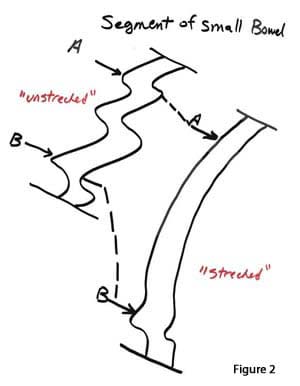
Depending on how much force is applied to it, it can be of different lengths. A similar analogy is the phone cord to head set of a conventional phone. The spiral cord placed on a table will coil up to a certain length. If one then pulls on two ends it will measure longer. And if more pull is exerted, then it will easure even longer. This demonstrates that the absolute measured length of the small bowel, is directly related to the force with which it is pulled. What this means is that if two individuals measure the length of the headset cord, or the bowel, they will get two different lengths, both correct but not the same. The length is directly proportional to the pull force applied to both ends.
Furthermore; the length of the small bowel is determinant of the absorptive capacity (amongst other factors). The longer the small bowel the more absorption, and the shorter the small bowel, the less absorption. There is a general-trauma surgical problem knows as short gut syndrome, where the length of the bowel is so short that it cannot support maintenance of the electrolytes and minerals, in additions to the required absorption of the calories. Short gut syndrome is a very difficult surgical problem to solve.
Getting back to our discussion however, we can now appreciate how two
surgeons can measure the same amount of small bowel (the same absorptive capacity) but end of with different lengths of small bowel. Same amount of bowel, same absorptive capacity, different lengths. This is why comparing lengths of small bowel is probably not the most accurate way to. Two patients, both with 75 cm common channels may have very different absorptive capacity, unless the bowel was measured by the same surgeon, and both patients had the same amount of total bowel length. We should next consider a possible alternative. Consider the drawing on (figure 3) and (figure 4).
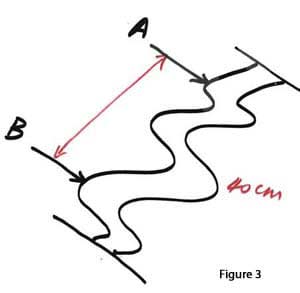
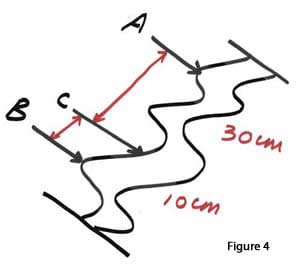
The distance between C and B is 25% (quarter) of the total length between A and B. This represents a segment of bowel that was measured and marked Now lets take the same amount of bowel and apply a little more pull force to the ends while measuring it. We will have a total length of 80 cm, between A and B (figure 5). The distance between A and C will be 60 cm and the distance between C and B will be 40 cm (figure 6). The absolute lengths then are double of the first case. Same amount of bowel, same absorptive capacity yet double the length. Does this mean that the second patient with distance between C and B at 20 cm will absorb twice as much as the first patient? The answer is no, since it was the same amount of bowel that was measured with different technique.
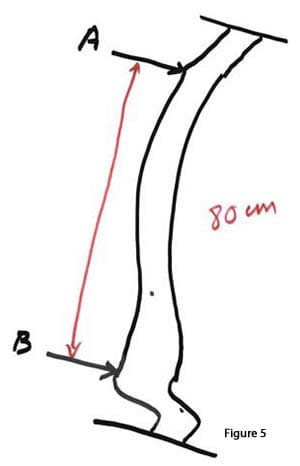
Lets now however look at this from another perspective. In both cases the distance between C and B was only 25% of the total length.
| Distances | Figures 3 & 4 | Figures 5 & 6 |
| Total length A-B | 40 cm | 80 cm |
| A-C | 30 cm | 60 cm |
| % of total | 25% | 25% |
The table above shows why lengths of bowel discussed in-terms of percentage of total may be a more standardized than the absolute numbers.
In this example both patient will have same absorptive capacity (25%) yet will have much longer absolute lengths. In our practice, we measure the total length and the common channel and the alimentary lengths are based on the patient BMI, comorbidities, age, sex, and activity level.
Please remember that this is only my opinion, different surgeons do it differently.