
Category: Sleeve Gastrectomy
What size is my Bougie?
July 10, 2014 6:57 pm
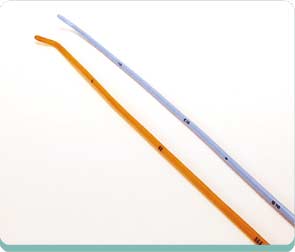
A Bougie is a flexible plastic tube that comes in different sizes. It can be used to calibrate the size of the stomach during the duodenal switch or Sleeve gastrectomy. It is also used to dilate strictures of the esophagus or the stomach.
I am commonly asked what size is the bougie that I use. My usual answer is that it is equivalent to a 38 or so, and that the size does not matter.
Many surgeons do not use these types dilators, but rather alternative tubes that function as a sizer and a suction tube to eliminates the need for multiple tube insertions and removals.
The July 2014 publication of Obesity Surgery had and article by Spivak et.al. titled “Laparsocopic Sleeve Gastrectomy Using 42-French Versus 32-French Bougie: The First-Year Outcome.” In conclusion they reported that using 42 vs 32 French Bougie does not influence the weight loss of resolution of the combed condition in the first year.
There also other studies that support the position of erring on the side a larger sizer, a 40-French, to decrease the leak rate without having an impact on the excess weight loss at 3 years time.
The take home massage is that the size of the stomach after the sleeve does not predict the outcome of the weight loss surgery independently. There are multiple factors in play such as age, amount of excess weight, diet adherence and exercise.
Revision or Reversal of the Duodenal Switch
September 08, 2012 7:00 pm
A significant portion of my practice involves the revision of the Gastric bypass and Adjustable Gastric Banding procedures to the Duodenal Switch operation. The re-operations are necessary to correct the complications that have been caused by these procedures. There are also instances of required revisions due to inadequate weight loss or weight regain. Our website contains detailed information regarding reasons for revision and the reversal of weight loss surgical procedures. I think it is important to mention that these complications are very common and almost never have anything to do with the patient’s behavior.
Duodenal switch operations may also require reversal or revision. The general reasons for a revision or reversal of the Duodenal Switch is the same as for all weight loss surgical procedures and include a variety of reasons. The reversal or revision of the Duodenal Switch operation is one of the simplest revision surgeries that I perform.
Let’s review a few facts about Duodenal switch.
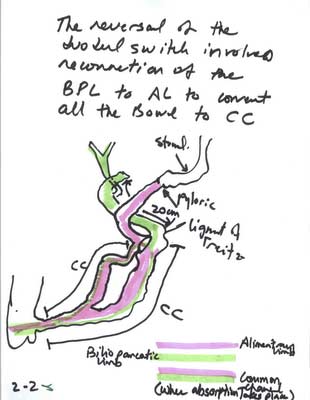
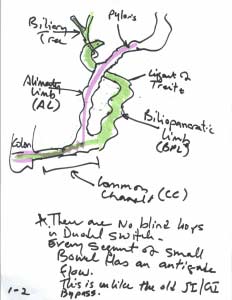
The Duodenal Switch procedures has two components:
1.) The sleeve gastrectomy
2.) The separation of the biliopancreatic secretions from the food to limit its absorptions.
Clearly, the portion of the stomach that has been removed cannot be reintroduced to the abdominal cavity. The second part of the operation can, however, be easily “undone.
The assumption is that the bowel needs to be divided again and re-anastomosed to reconstitute its continuity. This revision or reversal of the Duodenal Switch operation is done by simply creating a new connection between a new anastomosis, located between the biliopancreatic limb, and the alimentary limb.
If a complete reversal is needed, then the connection is made just distal to the ligament of Treitz. Ligament of Treitz is the transition point between the duodenum and Jejunum. This single anastomosis is safe and simple to perform and does not involve removing the previous staple lines.
If a partial revision is needed, or the common channel needs to be lengthened, then the anastomosis is made further proximal to the junction of both the alimentary limb and the biliopancreatic limb, but distal to the ligament of Treitz to allow for increased absorption of the calories and nutrientsIn my opinion, the revision and reversal of the Duodenal Switch operation is, from a technical perspective, the simplest of all revisional weight loss surgical procedures.
In my opinion, the revision and reversal of the Duodenal Switch operation is, from a technical perspective, the simplest of all revisional weight loss surgical procedures.
Gastric Emptying after the Duodenal Switch and the Sleeve Gastrectomy
January 19, 2012 1:10 am
Sleeve Gastrectomy post operative diet
January 03, 2012 11:15 pm
A relatively common question asked post operatively regards the pace at which the post operative diet should be advanced. In our practice, patients are given a simple list describing 3 broad categories. They are outlined in the work book.
Each patient should advance his or her diet over a 1-4 weeks in the post operative timeframe. The most important point to remember is that each one of us responds differently to the food at a certain point following surgery. The safest method to advance the diet would be to pay attention to what your body is telling you. If a patient is tolerating Bariatric 1 and Bariatric 2 diet, then they should be able to advance to a soft diet in one or two weeks. Alternatively, if the patient is having difficulty getting their required water on a daily basis, then advancing to a soft diet may be an incorrect move at that point.The basic order of food is water, protein, and everything else.
Yearly lab and medication requests
October 17, 2011 5:28 pm
As the years pass, weight-loss surgery patients, like everyone else, will require routine screening for certain chronic conditions. What is important is ensuring your primary care team is aware of the need for specialty testing to monitor vitamin and mineral levels.
You should also check with one of the labs and your insurance company to make sure they are a contracted facility and that the order is covered under your policy. It is your responsibility to ensure that your insurance company will pay for the ordered labs. We are in no way responsible for verifying the benefits of the laboratory services we order.
It is critical that patients who have undergone weight-loss surgery receive continuous annual follow-up care and monitoring. It is critical that patients continue to receive yearly follow-up care, not only by completing their scheduled laboratory studies but also by attending an in-office follow-up exam. Patients are welcome to contact our office and schedule an in-person or virtual follow-up.
Vitamin D supplements
August 01, 2011 1:12 am
“Common bile duct is dilated”
March 10, 2011 8:16 am