
Home » GLP-1
Tag: GLP-1
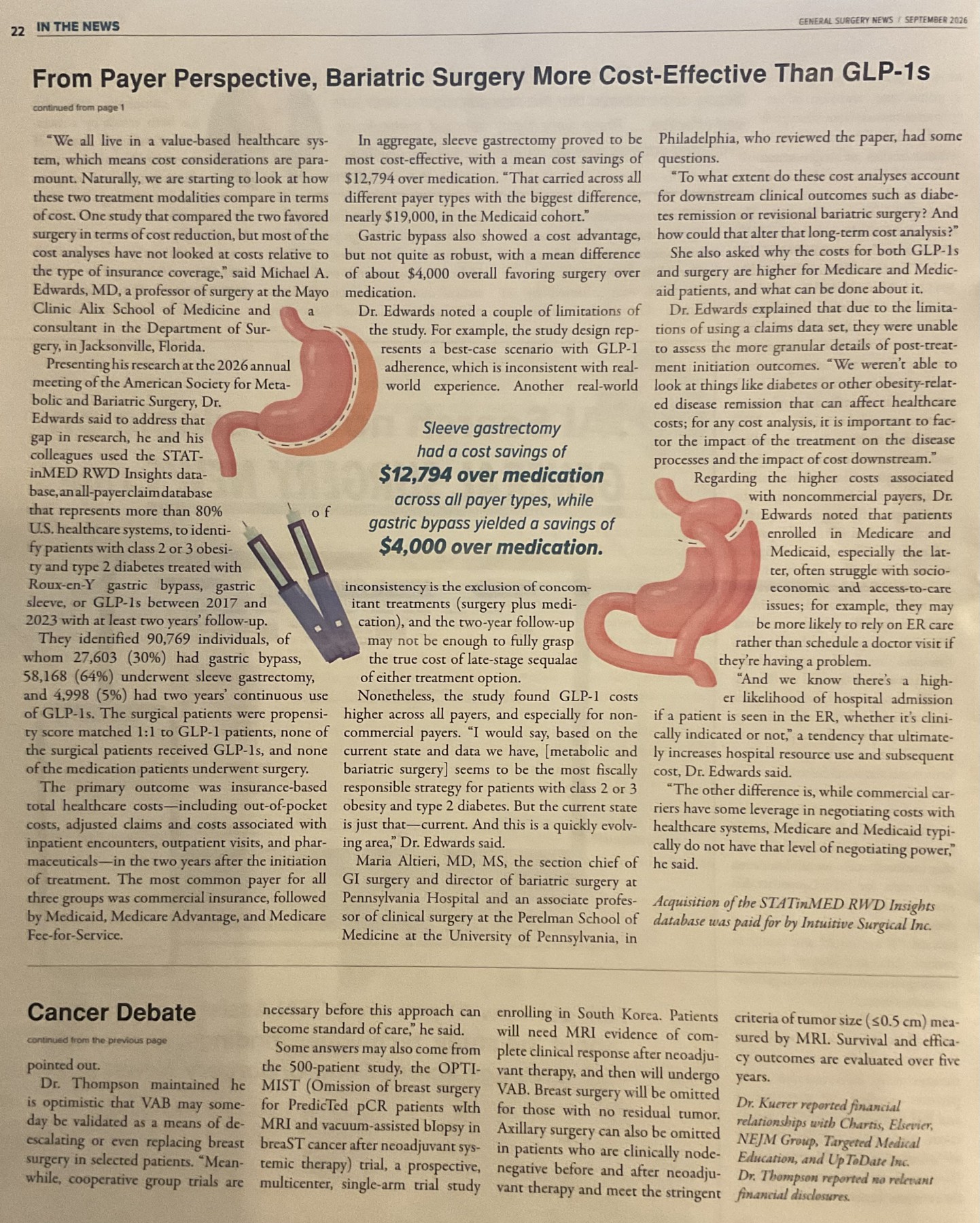
Sleeve more cost effective than GLP-1
October 30, 2026 8:25 am
Click the image or here to read the full article (General Surgery News, September 2026, page 22) »
GLP-1 medications cost less up front than metabolic and bariatric surgery. New research suggests surgery is still the better deal for payers over time. This is especially true for patients with class 2 or 3 obesity and type 2 diabetes, and for those on Medicaid. Dr. Michael A. Edwards of Mayo Clinic presented the study at the 2026 annual meeting of the American Society for Metabolic and Bariatric Surgery. His team used an all-payer claims database covering more than 80% of U.S. healthcare systems. They identified 90,769 patients treated between 2017 and 2023 with gastric bypass, sleeve gastrectomy, or at least two years of continuous GLP-1 use. The team matched surgical patients 1:1 with GLP-1 patients and compared total healthcare costs over the two years after treatment began.Key findings
- Sleeve gastrectomy was the most cost-effective option. It saved an average of $12,794 compared with medication.
- The biggest gap was in the Medicaid group, where savings came to nearly $19,000.
- Gastric bypass saved about $4,000 on average compared with medication.
- GLP-1 costs were higher for every payer type, especially Medicare and Medicaid.
Why government payers see bigger differences
Dr. Edwards noted that Medicare and Medicaid patients often face socioeconomic and access-to-care barriers. That makes them more likely to rely on the ER, which raises the chance of hospital admission. Medicare and Medicaid also have less power than commercial insurers to negotiate prices.Surgery Bests Lifestyle Changes, GLP-1 for Durable Weight loss
September 11, 2024 9:04 pm

SAN DIEGO-Bariatric surgery far outperforms lifestyle interventions and glucagon-like peptide-1 (GLP-1) medications at maintaining weight loss, according to a meta-analysis presented at the 2024 annual meeting of the American Society for Metabolic and Bariatric Surgery.
With results from six randomized controlled trials, three systematic reviews, and more than 40,000 patients, the study is the first synthesis of its kind.
“The analysis included two systematic reviews of bariatric surgery, one of Roux-en-Y gastric bypass including8,665 patients and one of sleeve gastrectomy including 6,095 patients: a single systematic review or lifestyle interventions including 723 patients; and six randomized controlled trials of GLP-1 medications, including four studies of semaglutide with a total of 11,871 patients and two of tirzepatide with 3,209 patients.
Lifestyle interventions were the least effective treatment, the investigators found, producing a mean total body weight loss of 7.4% at the end of the treatment period, followed by a mean per-month weight regain of 0.14%, with participants reaching their pre-intervention weights within 4.1 years.
GLP-1 medications proved more effective. Weekly semaglutide injections for 20 weeks and tirzepatide for 36 weeks produced a mean total body weight loss of 10.6% and 21.1%, respectively. Roughly half of the weight lost was regained within a year after stopping injections; with continued injections, weight loss plateaued after 17 to 18 months, at 14.9% for semaglutide and 22.5% for tirzepatide.
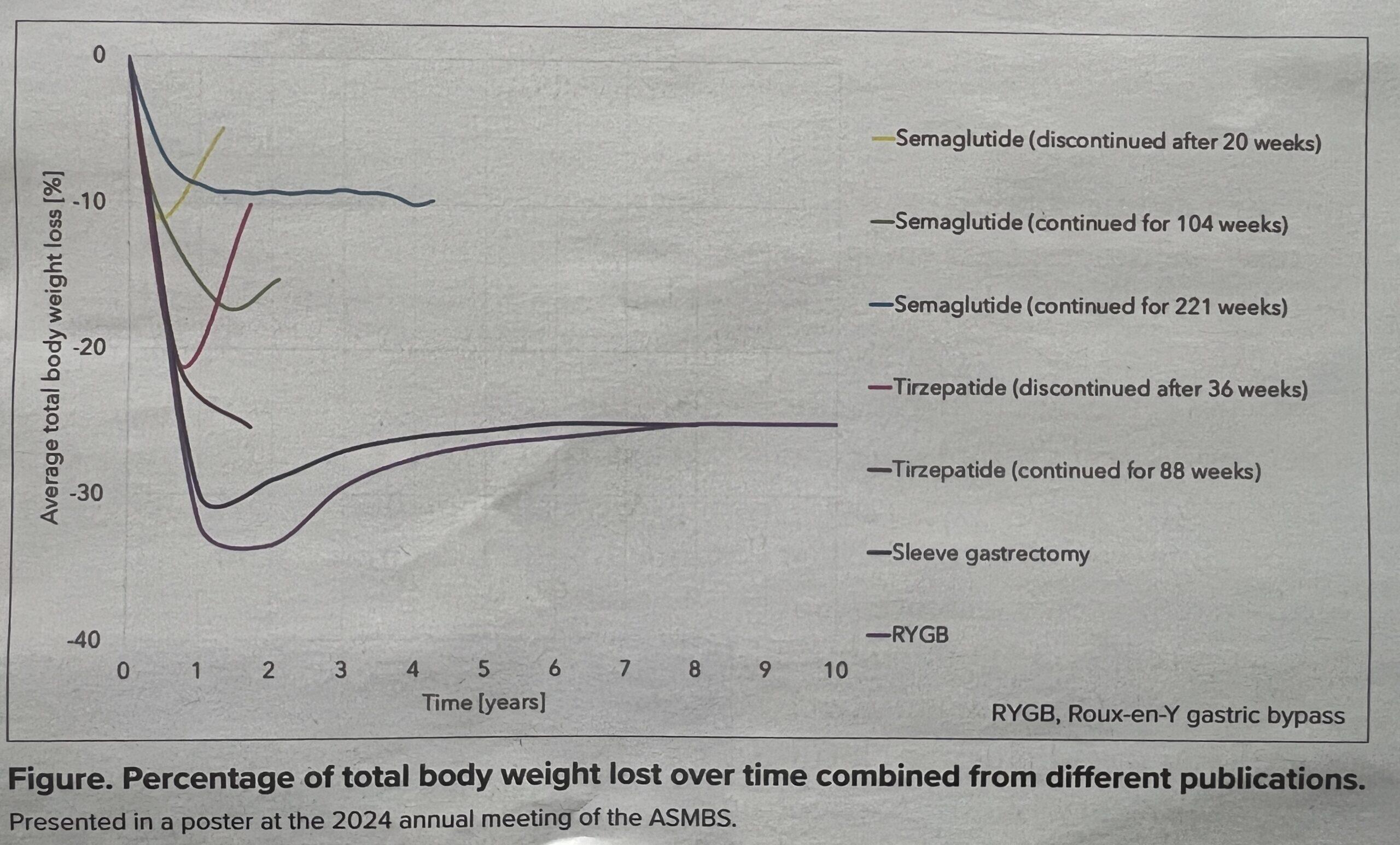
Outcomes after surgery were significantly better. Gastric bypass surgery and sleeve gastrectomy resulted in a mean total body weight loss of 31.9% and 29.5%, respectively, one year after surgery. Accounting for weight regained in the decade after surgery, both procedures produced a stable total body weight loss of approximately 25%.
While the results demonstrate a striking difference favoring surgery, lead investigator Megan Jenkins, MD, a bariatric surgeon at NYU Langone Medical Center in New York City, emphasized that surgery and medication ought to be viewed not in opposition but through a holistic lens as options and potential complements based on the needs of each patient.
“One of the big benefits of these new medications is that it’s helped us to treat obesity as a chronic disease,” Dr. Jenkins said. “We’ve always treated it that way, but I think the medical field has had trouble truly seeing it as a chronic disease. Like diabetes and high blood pressure, for example, which have always been treated with a combination approach.
Weight loss Medications compared to surgery
February 20, 2024 5:44 pm

- Is Sucralose (Splenda) Bad for You? What the Science Says November 5, 2026
- Sleeve more cost effective than GLP-1 October 30, 2026
- Cholangitis May 24, 2026
- Bile Reflux Gastritis May 19, 2026
- Sphincter of Oddi Dysfunction April 26, 2026