
Tag: endoscopic sleeve gastroplasty
Surgery for Sustained Weight Loss
January 07, 2026 1:31 pm
Short-Term Results vs. Decades of Data
Studies of GLP-1 and GIP medications report outcomes at one, two or three years. By comparison, weight-loss surgical procedures have outcome data spanning 15 to 30 years. These medication studies also tend to downplay the high cost and the long-term risks of injections or pills taken every day or every week.Endoscopic Gastroplasty: What the 5-Year Data Show
Now to the latest trend. Studies report endoscopic sleeve gastroplasty (ESG) results at three to five years. Like other low-risk alternatives, these reports emphasize short-term weight loss and short-term improvement in related conditions. However, the 5-year weight loss is a disappointing 11.8% of total body weight (Lahooti et al., 2025). For example, a 300-lb person will lose about 34 lb in 5 years after gastroplasty, compared with about 100 lb after sleeve gastrectomy. In addition, a meta-analysis found a 2.6% rate of serious adverse events after endoscopic gastroplasty (Singh et al., 2019). Yet many patients assume that because gastroplasty involves no incisions, it carries no serious risk.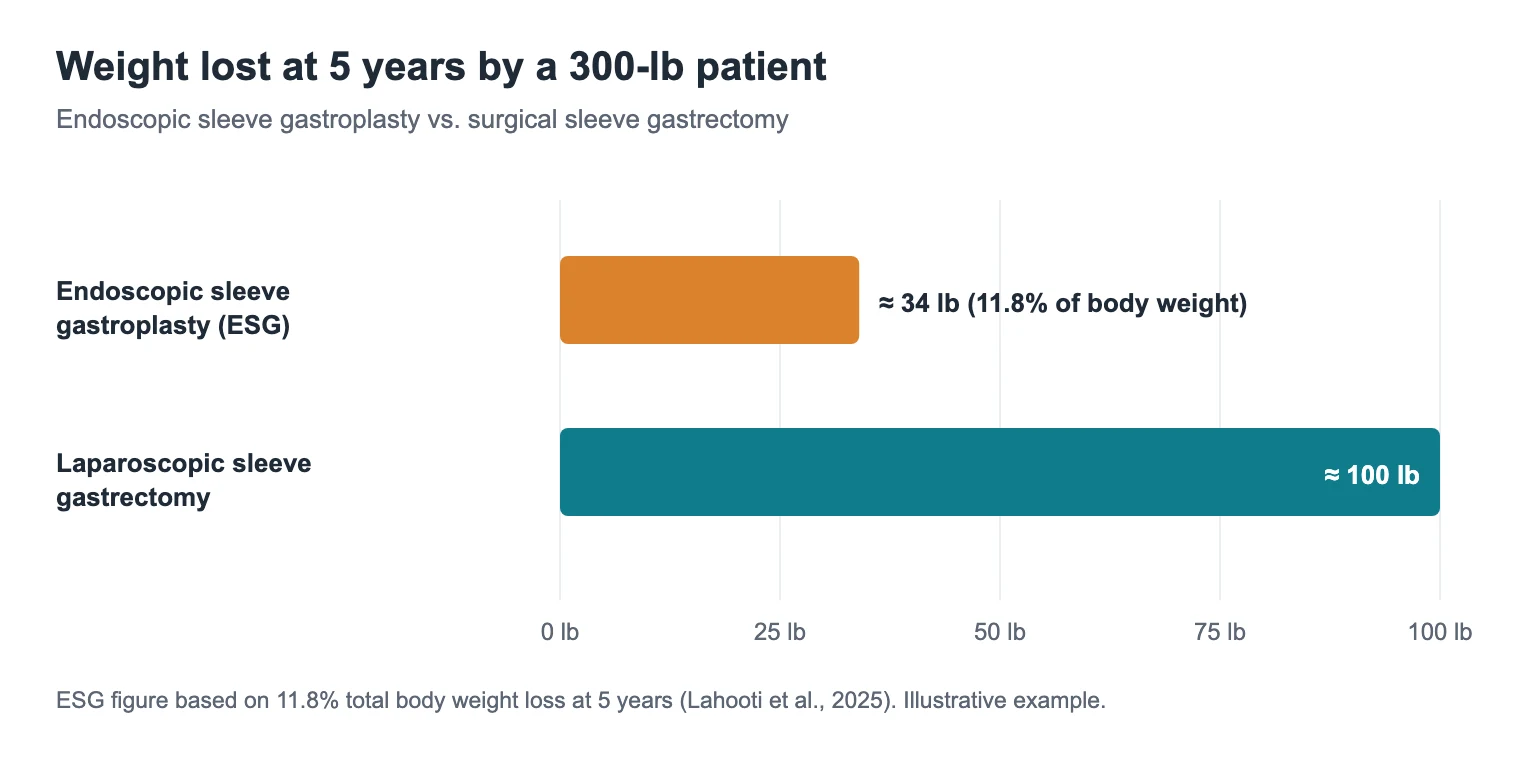
A Closer Look at the MERIT Trial
One of the first major studies (Abu Dayyeh et al., 2022) presented data that you have to read in detail to see how modest the results are:Between Dec 20, 2017, and June 14, 2019, 209 participants were randomly assigned to ESG (n=85) or to control (n=124). At 52 weeks, the primary endpoint of mean percentage of EWL was 49·2% (SD 32·0) for the ESG group and 3·2% (18·6) for the control group (p<0·0001). Mean percentage of total bodyweight loss was 13·6% (8·0) for the ESG group and 0·8% (5·0) for the control group (p<0·0001), and 59 (77%) of 77 participants in the ESG group reached 25% or more of EWL at 52 weeks compared with 13 (12%) of 110 in the control group (p<0·0001). At 52 weeks, 41 (80%) of 51 participants in the ESG group had an improvement in one or more metabolic comorbidities, whereas six (12%) worsened, compared with the control group, in which 28 (45%) of 62 participants had similar improvement, whereas 31 (50%) worsened. At 104 weeks, 41 (68%) of 60 participants in the ESG group maintained 25% or more of EWL. ESG-related serious adverse events occurred in three (2%) of 131 participants, without mortality or need for intensive care or surgery.Two points stand out:
- The study compared 85 patients who had endoscopic gastroplasty with 124 patients on diet and exercise alone. In other words, it did not compare ESG with sleeve gastrectomy.
- At one year, the ESG group had lost 49.2% of their excess weight. So a patient who needed to lose 100 lb lost only about 49 lb.
Weight Loss Must Last for Health Benefits to Last
GLP-1 and GIP medications have been promoted for nearly everything (a slight exaggeration to make the point). It is true that many obesity-related conditions improve with any form of weight loss. However, weight-loss surgery data also show that many of these conditions return when the weight comes back. That is why, in my opinion, it is misleading to highlight the resolution of these conditions after very small weight loss from the Lap-Band, gastric balloon or endoscopic gastroplasty. These conditions stay resolved only when the weight loss is maintained long term. Consider how each option maintains weight loss:- Lap-Band: ongoing adjustments, with their cost and the risk of complications such as band slippage or persistent nausea and vomiting.
- Gastric balloon: replacement every six months.
- GLP-1 and GIP medications: daily or weekly doses for life, with side effects and ongoing cost.
Why Surgery Delivers Sustained Weight Loss
Weight-loss procedures such as the duodenal switch, sleeve gastrectomy and gastric bypass are not risk-free. Nevertheless, study after study has shown that they deliver sustained weight loss over decades. As a surgeon with decades of experience operating on patients after failed Lap-Bands, endoscopic gastroplasty, GLP-1 and GIP medications, and gastric balloons, I hear one thing again and again: patients knew very little about their options. Patients who focus only on short-term results and the lowest perceived risk often end up needing a second treatment to get a lasting result.Questions to Ask Before Choosing a Weight-Loss Treatment
- How much weight do patients typically lose, and is that measured at 1 year, 5 years or 15 years?
- Was the treatment compared with surgery, or only with diet and exercise?
- What happens to my weight if I stop the treatment?
- What are the serious risks, and how often do they occur?
- What is the total cost over 5 to 10 years?
Related Articles
- Endoscopic Gastroplasty Is Not the Same as Sleeve Gastrectomy
- Sleeve More Cost-Effective Than GLP-1
- SADI, SIPS and Loop DS Are Not the Same as the Duodenal Switch
References
Abu Dayyeh, B. K., Bazerbachi, F., Vargas, E. J., et al. (2022). Endoscopic sleeve gastroplasty for treatment of class 1 and 2 obesity (MERIT): a prospective, multicentre, randomised trial. Lancet, 400(10350), 441–451. https://doi.org/10.1016/S0140-6736(22)01280-6 Lahooti, A., Westerveld, D., Johnson, K., et al. (2025). Improvement in obesity-related comorbidities 5 years after endoscopic sleeve gastroplasty: a prospective cohort study. Gastrointestinal Endoscopy, 102(1), 26–36. https://doi.org/10.1016/J.GIE.2024.12.017 Singh, S., Hourneaux de Moura, D. T., Khan, A., et al. (2019). Safety and efficacy of endoscopic sleeve gastroplasty worldwide for treatment of obesity: a systematic review and meta-analysis. Surgery for Obesity and Related Diseases, 16(2), 340. https://doi.org/10.1016/J.SOARD.2019.11.012Endoscopic Gastroplasty Is Not the Same as Sleeve Gastrectomy
December 19, 2025 11:57 am
What Is Endoscopic Gastroplasty?
First, in endoscopic gastroplasty, a doctor passes a flexible scope through the mouth and places sutures inside the stomach. As a result, these sutures fold the stomach into a narrower tube. The doctor removes nothing, and there are no incisions on the abdomen. However, the sutures can loosen over time, and the stomach can stretch.What Is Sleeve Gastrectomy?
By contrast, in a laparoscopic sleeve gastrectomy, a surgeon removes about 75–80% of the stomach through small incisions, leaving a narrow, banana-shaped tube. Because this portion of the stomach never grows back, the change in stomach size and hunger hormones is lasting.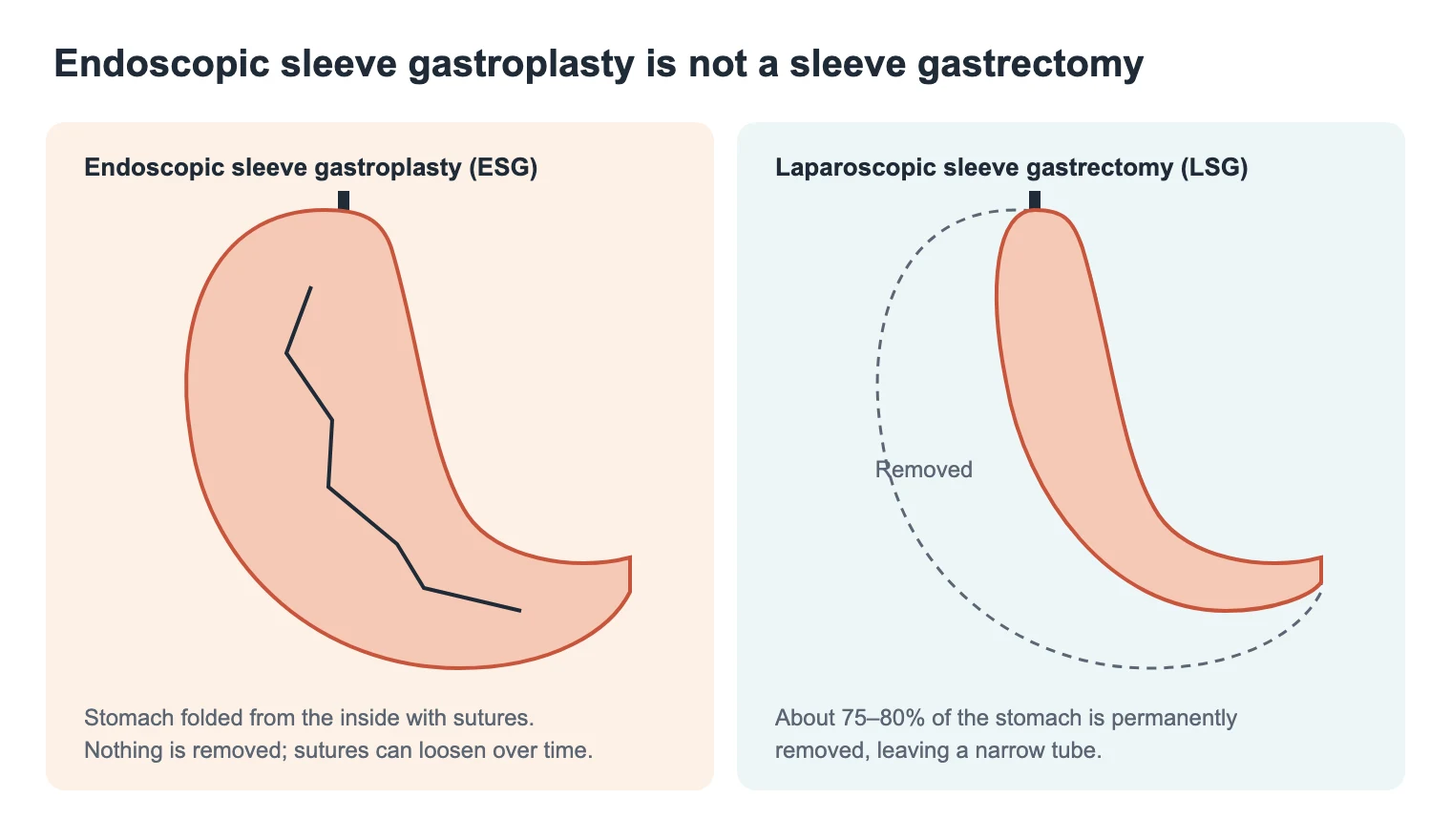
Endoscopic Gastroplasty vs. Sleeve Gastrectomy at a Glance
| ESG | Sleeve gastrectomy (LSG) | |
|---|---|---|
| How it is done | Scope through the mouth; sutures fold the stomach | Laparoscopic surgery through small incisions |
| Stomach removed? | No | Yes, about 75–80% |
| Weight loss | About 12–14% of body weight (1 to 5 years) | Substantially more, maintained long term |
| Durability | Sutures can loosen; long-term data are limited | Decades of outcome data |
What the ASMBS Actually Says
In fact, even in its press release, the ASMBS highlighted the difference:In short, while ASMBS does not consider the ESG equivalent to metabolic and bariatric surgery (e.g., sleeve gastrectomy, gastric bypass) when it comes to expected weight loss or metabolic impact, it does fall within a treatment continuum that includes lifestyle therapy, obesity management medications (OMMs), and metabolic and bariatric surgery and should be available to patients through bariatric and metabolic surgeons.
Who Might Consider Endoscopic Gastroplasty?
In my opinion, as supported by the published literature and the ASMBS position statement, endoscopic gastroplasty may be appropriate for some patients. However, patients should understand that weight loss after ESG is slower and smaller than after sleeve gastrectomy. In addition, most studies have included people with a BMI of 30 to 40.Questions to Ask Before Choosing ESG
- How much weight do patients typically lose at 5 years, not just at 1 year?
- Did researchers compare the procedure with sleeve gastrectomy, or only with diet and exercise?
- What happens if the sutures loosen or I regain weight?
- Can a surgeon convert ESG to a sleeve gastrectomy or another operation later?
Related Articles
- Surgery for Sustained Weight Loss
- Endoscopic Sleeve Gastroplasty vs. Laparoscopic Sleeve Gastrectomy
- Sleeve More Cost-Effective Than GLP-1