
1-818-812-7222 Office Hours: Monday Thru Friday: By Appointment only
Home » Insurance
Category: Insurance
Sleeve more cost effective than GLP-1
October 30, 2026 8:25 am
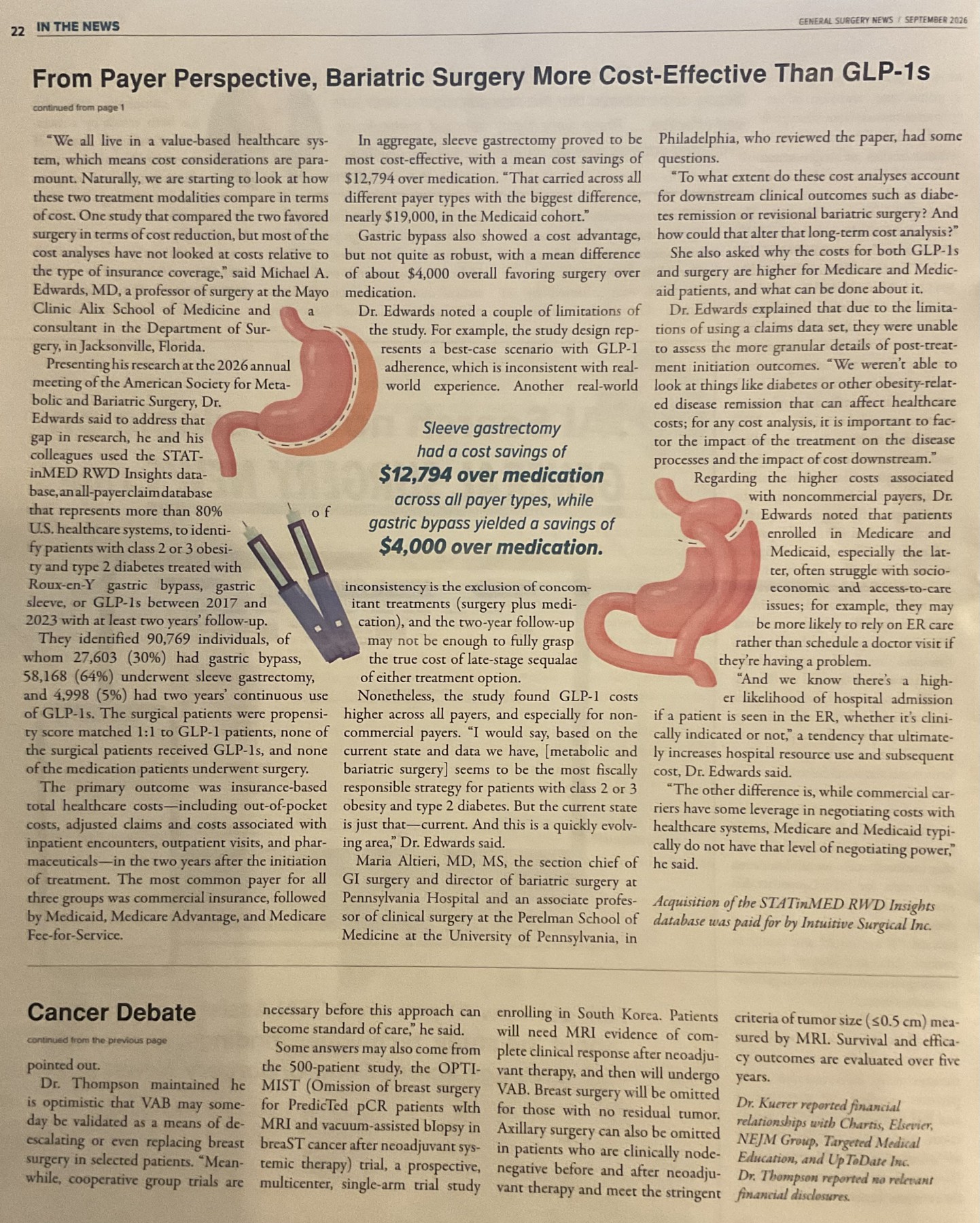
Click the image or here to read the full article (General Surgery News, September 2026, page 22) »
GLP-1 medications cost less up front than metabolic and bariatric surgery. New research suggests surgery is still the better deal for payers over time. This is especially true for patients with class 2 or 3 obesity and type 2 diabetes, and for those on Medicaid. Dr. Michael A. Edwards of Mayo Clinic presented the study at the 2026 annual meeting of the American Society for Metabolic and Bariatric Surgery. His team used an all-payer claims database covering more than 80% of U.S. healthcare systems. They identified 90,769 patients treated between 2017 and 2023 with gastric bypass, sleeve gastrectomy, or at least two years of continuous GLP-1 use. The team matched surgical patients 1:1 with GLP-1 patients and compared total healthcare costs over the two years after treatment began.Key findings
- Sleeve gastrectomy was the most cost-effective option. It saved an average of $12,794 compared with medication.
- The biggest gap was in the Medicaid group, where savings came to nearly $19,000.
- Gastric bypass saved about $4,000 on average compared with medication.
- GLP-1 costs were higher for every payer type, especially Medicare and Medicaid.
Why government payers see bigger differences
Dr. Edwards noted that Medicare and Medicaid patients often face socioeconomic and access-to-care barriers. That makes them more likely to rely on the ER, which raises the chance of hospital admission. Medicare and Medicaid also have less power than commercial insurers to negotiate prices.Aetna and Blue Shield 6 month Diet Requirement Changes
May 15, 2015 3:16 pm
- Member’s participation in a physician-supervised nutrition and exercise program must be documented in the medical record by an attending physician who supervised the member’s participation. The nutrition and exercise program may be administered as part of the surgical preparative regimen, and participation in the nutrition and exercise program may be supervised by the surgeon who will perform the surgery or by some other physician. Records must document compliance with the program; the member must not have a net gain in weight during the program. Note: A physician’s summary letter is not sufficient documentation. Documentation should include medical records of physician’s contemporaneous assessment of patient’s progress throughout the course of the nutrition and exercise program. For members who participate in a physician-administered nutrition and exercise program (e.g., MediFast, OptiFast), program records documenting the member’s participation and progress may substitute for physician medical records; and
- Nutrition and exercise program must be supervised and monitored by a physician working in cooperation with dieticians and/or nutritionists, with a substantial face-to-face component (must not be entirely remote); and
- Nutrition and exercise program(s) must be for a cumulative total of 6 months (180 days) or longer in duration and occur within 2 years prior to surgery, with participation in one program of at least 3 consecutive months. (Precertification may be made prior to completion of nutrition and exercise program as long as a cumulative of 6 months participation in nutrition and exercise program(s) will be completed prior to the date of surgery.)
Recent Posts
- Is Sucralose (Splenda) Bad for You? What the Science Says November 5, 2026
- Sleeve more cost effective than GLP-1 October 30, 2026
- Cholangitis May 24, 2026
- Bile Reflux Gastritis May 19, 2026
- Sphincter of Oddi Dysfunction April 26, 2026