
1-818-812-7222 Office Hours: Monday Thru Friday: By Appointment only
Home » CT scan cancer risk
Tag: CT scan cancer risk
Imaging Technology and CT Scan Cancer Risk: What Patients Should Know
April 16, 2025 1:22 pm
What the 2025 Study Found About CT Scan Cancer Risk
A new study in JAMA Internal Medicine has documented the increased risk of cancer associated with radiation from diagnostic CT scans:
- About 93 million CT scans were performed on 62 million patients in the United States in 2023.
- Researchers projected that these scans could lead to about 103,000 future cancers over the patients’ lifetimes.
- The most common projected cancers were lung, colon and bladder cancer and leukemia, and breast cancer in women.
- CT scans of the abdomen and pelvis accounted for the largest share, about 37% of projected cancers.
- The risk per scan was highest in children, especially infants, while adults accounted for most cases because they have far more scans.
- If current practices continue, CT-related cancers could eventually make up about 5% of new cancer diagnoses each year.
Which Imaging Tests Use Radiation?
Not all imaging carries the same exposure. For example, ultrasound and MRI use no ionizing radiation, while a CT of the abdomen and pelvis delivers roughly 100 times the dose of a chest X-ray.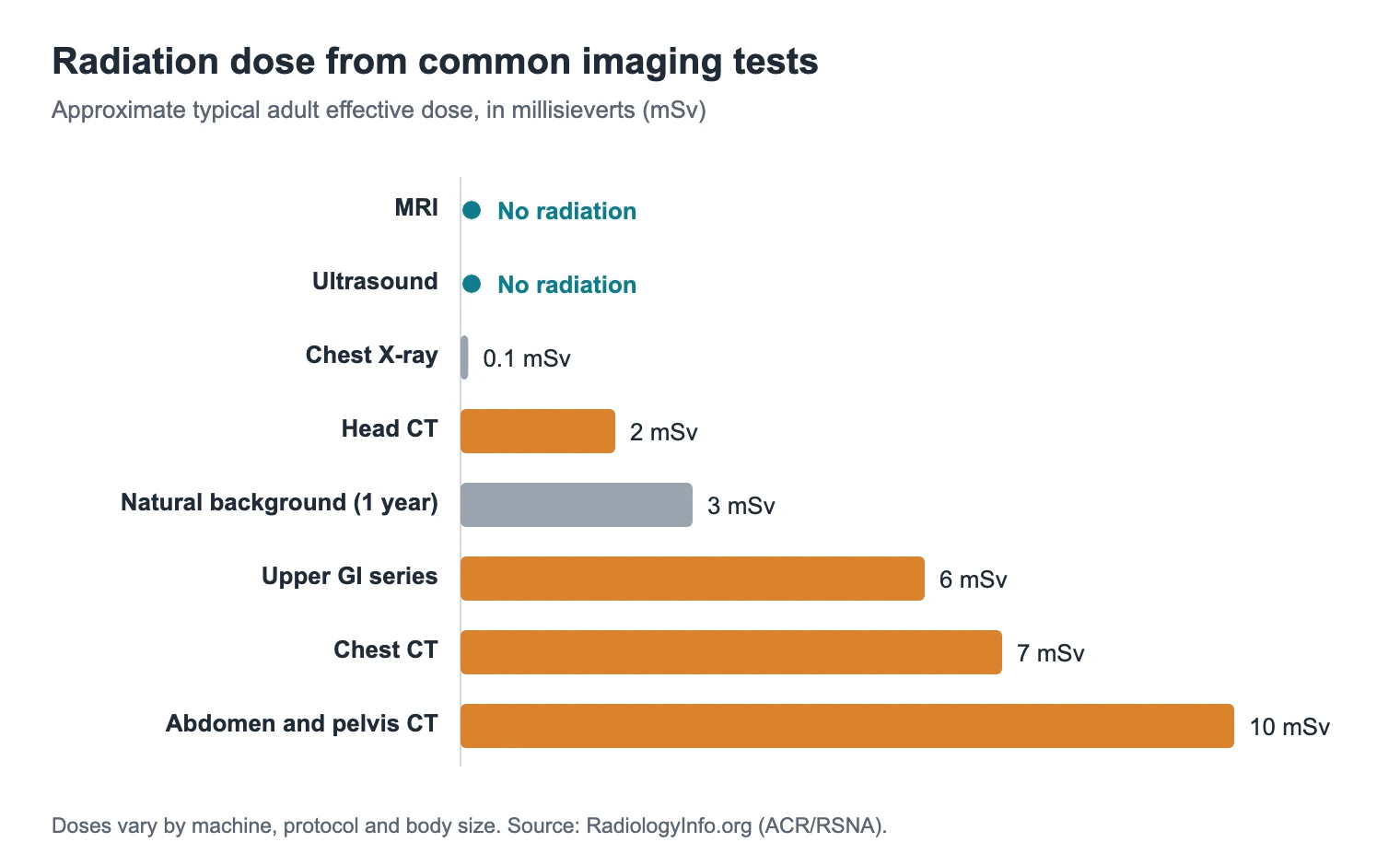
Questions to Ask Before a CT Scan
Before ordering or agreeing to any diagnostic test that involves radiation, we should all ask:- What information am I trying to get?
- Have I had a similar test before? If so, do I have access to the records and images?
- Will the result change my treatment?
- Could an ultrasound or MRI answer the same question without radiation?
- If a CT is needed, can it be done with a lower-dose protocol?
How to Lower Your CT Scan Cancer Risk: Keep Your Imaging Records
This is why I always recommend that patients keep the reports and images from every radiology study they have. When your records are readily available to you and your healthcare providers, you are less likely to have a scan repeated unnecessarily. As a result, you reduce your total radiation exposure.- Ask for a copy of every report, and request the images on a disc or through the imaging center’s online portal.
- Keep a simple list of your scans with the date, body area and facility.
- Bring this list and your images to every new specialist or emergency visit.
A Note for Weight-Loss Surgery Patients
Patients who have had weight-loss surgery often see several doctors over many years, and abdominal pain sometimes leads to repeated CT scans. In this situation, having your prior images on hand matters even more. Moreover, some conditions, such as superior mesenteric artery syndrome, do require CT imaging to diagnose, so each scan should answer a clear question.Related Articles
Questions about whether a scan is right for you? Contact our office at 1-818-812-7222 to schedule an appointment. Reference: Smith-Bindman R, Chu PW, Azman Firdaus H, et al. Projected Lifetime Cancer Risks From Current Computed Tomography Imaging. JAMA Intern Med. 2025;185(6):710–719. doi:10.1001/jamainternmed.2025.0505Recent Posts
- Copper: The Essential Mineral Your Body Cannot Live Without November 18, 2026
- Superior Mesenteric Artery Syndrome (SMAS) November 18, 2026
- Is Sucralose (Splenda) Bad for You? What the Science Says November 5, 2026
- Sleeve more cost effective than GLP-1 October 30, 2026
- Cholangitis: Causes, Risk Factors and Treatment May 24, 2026