
Category: Uncategorized
Erin C
January 09, 2010 1:03 pm
Erin’s Stats
DS Veteran: Erin C.
Location: ON, Canada
Surgery Date: Sept 17, 2008
Surgeon: Marek Lutrzykowski, MD
Highest Weight: 287 lbs
Pre-op BMI: 44
Pre-op Weight: 282 lbs
Goal Weight: 140 lbs
Current BMI: 22
Current Weight: 140 lbs
Erin’s Message
The DS has changed my life in so many ways. I now have the confidence to get out in the world and be seen. I play with my kids, have energy, and have even run in a 5k race with my son! I had ben approved for surgery in 2005, and 2 weeks before, called and cancelled – I was terrified. After another round of losing and regaining weight, I decided to try again, and it was the best thing I’ve ever done for myself! I’m so glad I didn’t let fear stop me, because I would be barely living if I had.
See Erin in OH MAGAZINE JAN/FEB 2010 edition

Jillian O
January 09, 2010 12:53 pm
Jillian’s Stats
DS Veteran: Jillian O.
Location: IL, USA
Surgery Date: Dec 11, 2000
Surgeon: A. Hares, MD
Highest Weight: 408 lbs
Pre-op BMI: 58
Pre-op Weight: 406 lbs
Goal Weight: 240 lbs
Current BMI: 31
Current Weight: 219 lbs
Jillian’s Message
I’ve always been a “big” person. I come from a big family, in that they are all taller than I am. My mother is 6’0″ and my brothers are each well over six feet themselves. I was my full height of 5’10” by the third grade. Even though I wasn’t fat necessarily, I was big in stature and didn’t have a prayer of being an average sized person. I was very physically active when I was young. I played all kinds of sports, t-ball, softball, basketball and volleyball all the way through high school. I used to ride my bike for miles at a time each day, as that was my freedom from a home life I just assumed avoid. I look back on my body at that time and I look at it with amazement. I was in such good shape, but I didn’t know it. I thought I was a fat cow!! I was told so almost every day.
I didn’t start to gain weight until I reached my 20’s and started to slow down my physical activity level. Part of me thinks that gaining weight was a way to make my internal and external selves finally match. I saw a fat person in the mirror every day, so actually gaining weight wasn’t a noticeable or alarming change.
I gained weight over the course of many years. I built a very strong physical wall around myself. I managed to avoid a lot of the co-morbidities that others talk about. I was on thyroid medication and a mild water pill for the beginning signs of hypertension.
I finished college and got a great job that led to a promotion that required I move out of state. I was in a new city and state and aside from friends at work, I spent my time alone – eating. Eventually, my life revolved around the fact that I was extremely obese. I didn’t have a lot of energy. I had to plan where I went and where I sat to avoid embarrassing myself too much.
Fortunately, my weight didn’t impact my upward movement within my company and I was eventually sent to graduate school, sponsored by my company. Right before I decided to have weight loss surgery, I was working full-time and going to graduate school full-time. I realized that I needed to do something to tackle my weight once and for all. My whole life I was on a diet, planning to start a diet or feeling guilty for screwing up a diet. So, after my first year of grad school, during the Christmas break, I had the open DS surgery. That was December 11th, 2000. The day before my 34th birthday.
I drove to the suburbs of Detroit, checked into a hotel, did my lovely bowel prep and was up and at the hospital at 4:00 AM the next morning. My father met me at the hospital and got there in time for me to give him a copy of my will and letters for every member of my friends and family in the event that I didn’t make it through. I knew the seriousness of the surgery, but I also knew I couldn’t continue to live my life the way I had been.
After 5+ hours of surgery, I had been switched and was in recovery. I spent 5 days in the hospital and then an additional two weeks in a hotel down the road from the hospital. My Dad stayed with me while I was in the hospital and got me settled into the hotel, where my Mom took over and stayed with me and then drove me back home to Illinois. I had someone with me, by my side for the first 5 weeks after surgery. I hadn’t had surgery before and didn’t know what to expect. Looking back, I could have gone it alone much earlier, but it was nice to have people there with me, just in case.
It’s been eight years now and I’ve lost 167 lbs. My life is completely different. I am very active, once again. Weight isn’t the first thing that people notice about me and I don’t feel the need to have the physical wall up anymore. The DS and really good therapy have given me back my life. It hasn’t always been perfect, you can see my story of weight regain and loss also posted on this site, but I wouldn’t change a thing about my journey thus far!
My advise to potential DS patients is to do your homework, don’t settle for anything less than what you want and stay connected to other DS patients, whether it’s through the DS forum, surgeon sponsored support groups or the Internet. Keeping connected and staying on top of the latest and greatest information on your surgery is key. My first initial response to losing my excess weight was that I didn’t want to focus on weight anymore, I just wanted to “move on” with my life and that’s where I got myself into trouble with some weight regain. That weight is gone now and I am feeling really good, because I am connected to a great community of DS patients and staying on top of my health! I wish you luck on your journey!
Articles by Jillian O.

Weight Regain
January 09, 2010 12:50 am
Jillian O.
This is my story about weight regain after Duodenal Switch. I had my DS eight years ago. At the time, not as much information about the DS post-op life was available, as there is today. It wasn’t uncommon to hear people say that they can eat everything they want without consequences. That may be true for some, but not all. The DS isn’t a free ride for everyone and weight regain is possible. This is my story of how I regained weight and what I’ve done about it. I started at 406 lbs. At the time I had my DS, there weren’t many surgeons performing it, so I had to travel out of state to get it done. The instruction I was given after surgery was simple, eat at least 80 grams of protein a day and make sure to eat it first. Anything else afterward that fits in your stomach is ok. The assumption being that after protein, you wouldn’t have much room for other foods. I became very active once I started to lose weight. I always enjoyed being active when I was younger so I started to run and lift weights five times a week. I think that really helped with my weight loss. At my lowest I was around 240lbs., which might seem high, but I actually looked really good at that weight. I am 5’10 and have very dense bones along with a lot of muscle mass – from working out. A few years later I had some plastic surgery procedures and loss a lot of blood making me anemic. It took six months of trial and error then going to a hematologist before I got a series of iron infusions. During these six months, I got very tired. I stopped working out and was so out of it that I would fall asleep at my desk. I basically worked and slept, that was it. I eventually had a weight regain of 20 lbs. I should have contacted my surgeon’s office or asked for advice on the DS board, but I didn’t. That probably would have resulted in getting the iron infusions a lot quicker. Lesson learned! At another point during the last eight years, I developed a bad case of IBS due to some external stresses in my life. I was in a lot of pain and discomfort all the time. I went to a specialist and had a colonoscopy and was told that it was IBS then I was given a diet to follow that would stop irritating my digestive system. I was so miserable that I would have done anything to feel better. So, I followed the diet that was very anti-protein and pro-carbs. If you google recommended diets for IBS, you will see what I mean. I gained back more weight from the diet and from lack of exercise due to being in pain. Once I eliminated the external stresses and followed the diet for a while, I eventually got better and the IBS went away completely. I think the fact that I entered into therapy helped a great deal as well. Last winter, I suffered a fall down some concrete steps. I slipped on some ice I didn’t see and landed at the bottom step on my arm and shoulder. I ended up shattering my right from the shoulder almost to my elbow and was immobilized for three months, then in intensive physical therapy for six months. During this time, I couldn’t do anything for myself. I sat at home; my friends and family brought me food and goodies, which I ate. I also gained more weight. So, over the course of 8 years and the three incidents I mentioned above, I had a weight regain of 50 lbs. I got way off track from how I should be eating and was just really disconnected from my body and all things DS. I knew I needed to make some changes to turn things around. I got back on the Obesity Help DS Forum and started asking questions. I found out how well informed everyone is about the DS now and got myself back on track. I started by tracking my daily food intake in fitday.com. Boy, was that eye opening! I realized and saw for myself just how upside down my protein and carb intake were. I didn’t change my eating habits right away, I kept tracking in fitday.com and started to read the daily food & fitness threads on the DS Forum to get an idea of how others were eating as well as getting food suggestions. After a couple of weeks, I started to cut way back on the carbs and add more protein into my daily diet. I started this process mid May 2008 and by June, I had made major shifts in how I was eating. I should also mention that I had been exercising regularly all along when I could. I started with solitary exercises like running on a treadmill and lifting weights. Later, I found a Pilates instructor and started taking equipment and mat classes. Pilates is something that I’ve come to love and started doing 4-5 times a week. I then added Zumba into the mix and got to the point where I was working out 8-9 hours per week and loving every minute of it. I think finding something that you love and something that doesn’t feel like work is the key. I’ve enjoyed getting more in tune with my body and spending time with the women in my classes. The result of the changes to my eating habits and the increased exercise has helped me lose all the weight I regained plus a few more, 55 lbs. in total. I am back in my skinny jeans and having to buy new clothes. I indulge occasionally and find that as long as I don’t indulge more often than I do, I am ok. Moderation is key. I still enjoy chocolate and goodies when craving them, but they aren’t daily staples anymore. In the course of the past six to seven months, I have got back to the basics with my eating, but I don’t feel deprived. I’ve increased my exercise, which I enjoy and have exceeded my original goal. Life is good!! The DS is fantastic!! It’s still working for me after all these years! Here are the DS basics as prescribed to me by the members of the DS Forum and what I’ve been following:- I eat 80-100 grams of protein per day
- I keep carbs at 50 grams or less per day
- I try to keep the carbs I do eat complex and only rarely eat simple carbs
- I drink at least 64 oz. of water or SF liquids every day
- I don’t worry about fat or number of calories
- I track my food on fitday.com every day
Denise
I’m 6 ft. tall and was 377 lbs. on the day of surgery. I was 50 years old and didn’t really set a specific goal, but being below 200 lbs. would have been nice. I lost 130 lbs. in the first year and a half, and if I stopped right there, I would have been happy. Not skinny, by any means, but I just wanted to feel lively and be active again which I did. At about 2.5 years out, I stopped focusing on protein and had a pretty steady diet of carbs and sweets. Cruelly, I never focused on sweets before the DS, but for some strange reason, I developed an unbelievable sweet tooth post op; I was always a salty/crunchy kind of person. Many post-op DS patients find it difficult to eat too many sweets, but not me. I never feel full when I’m eating sugary treats. I used to weigh myself daily, which helped me stay on track (that doesn’t work for everyone, but it’s a necessity for me). I totally lost control and gained 70 pounds in the next year. I hit 311 lbs. earlier this year. I’ve always been good about my vitamins and water, so my blood work has been fine. I have avoided beating myself up and also avoided considering myself a total failure at the DS. I simply fell back into old habits of letting my weight put up a wall to protect me from things I wanted to avoid in day to day life. Earlier this year, after addressing a few non-DS and non weight related health issues, I realized that I want to feel good again, just like I did a few years ago. I started around April of this year and here is how I got back on track: 1. I cut my carbs back to below 50. 2. I weigh myself daily. Beware, if you can’t be okay with daily fluctuations, this may not be a good thing for you to do. 3. For a few months, I tracked my food on the Daily Plate. Once I got back on track, I stopped the daily record, but will return to it if I feel out of control. Getting in over 100 grams of protein is easy for me; it’s keeping the carbs low that was more difficult. 4. I’ve cut out all major sugar for now. I’m sure I’ll be able to re-introduce sugary treats back into my lifestyle someday, but just not now. 5. I’ve continued to see a counselor because food has always been my coping and self-comforting mechanism, which I have to work on that daily. 6. I also refocused on how blessed I have been that I was able to have the DS after canceling my appt. for an RNY when I heard about this option. My insurance approved me in a matter of days. I also had incredible friends who traveled for 2 hours, took time off work to take turns and come and stay with me at a hotel for one week after I was released from the hospital. (I had my surgery in Dayton, but live in Columbus). Bottom line, I’ve now re-lost 38 of the regained 70 lbs. I am back on track and feeling great. I’ve started walking again, which I still hate doing, but I’m doing it. The DS continues to work. I may not be losing as fast as 4 years ago, but it’s still coming off faster than a non-WLS person. Yes, you can regain some weight on the DS if you stop eating protein first and slip back to poor dietary choices that will cause weight gain in everyone. I love not having to worry about fat. I do love DS and I’m thankful it continues to work, even 4 years later! As I said at the beginning, I’d do it all again in a heartbeat.John C
November 28, 2009 12:51 pm
John’s Stats
DS Veteran: John C.
Location: MI, USA
Surgery Date: June 20, 2008
Surgeon: Marek Lutrzykowski, MD
Highest Weight: 502 lbs
Pre-op BMI: 87.5
Pre-op Weight: 423 lbs
Goal Weight: 197 lbs (pre-plastics)
Current BMI: 33.8 (pre-plastics)
Current Weight: 197 lbs

Bowel Obstruction From “scar” Tissue
October 12, 2009 7:52 pm
One of the potential complications of any abdominal surgery is bowel obstruction. This can occur with open or laparoscopic operation. It can also occur within days or years of the operation. The over all incidence of bowel obstruction is relatively low.
The text book diagnostic criteria for bowel obstruction is the presence of a set of physical findings additional to the diagnostic supporting evidence. A typical patient may present with cramping abdominal pain, nausea, vomiting, absence of any flatus, and not bowel movements. The pain may be dull and could be any where on the abdomen. The White count may be elevated, and a plain abdominal Xray may show “airfluid” levels. All of these finding point to a patient that has bowel obstruction. Depending on the age and the history of the patient, the a common cause may he adhesions (scar tissue) that has cause a blockage of the bowel.
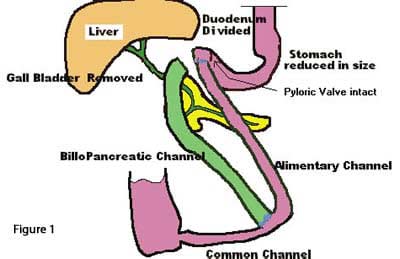
Unfortunately, these physical and radiological findings may not all be present in patients that have had the Duodenal Switch or the Gastric Bypass operation. The patients may complain of nausea but no vomiting. They may still pass gas and have bowel movements, but have cramping abdominal pain. The plain abdominal xray may not show air-fluid levels, yet have complete obstruction. The presence or lack of these findings can be explained.
In both the DS and the RNY operations, there are two parallel limbs (figure 1). One of them is connected to the esophagus, thus it can have air in it. The other limb is not connected to the outside on the proximal end (green limb in figure one only drain the bilio-pancreatic secretions and is not connected on the proximal end to the esophagus). This major anatomical difference explains why there may be air fluid level in a bowel obstruction patient with no DS or RNY, and no such finding in a DS or RNY patient.
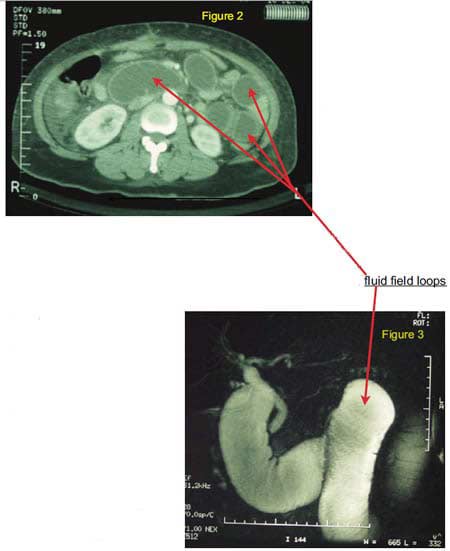
The most important diagnostic tool is a very high degree of clinical suspicion. The absence of vomiting, or air fluid levels on an abdominal xray, or the presence of flatus and bowel movements does NOT rule out a complete bowel obstruction. The more reliable way to diagnose a bowel obstruction after DS or RNY is by CT scan or and MRI (figure 2, 3).
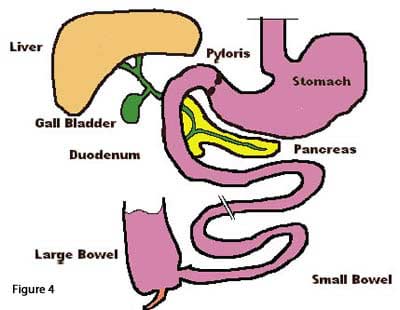
A finding of fluid field loops of bowel is highly specific for bowel obstruction and warrants a surgical intervention since it can not be corrected by a naso-gastric tube (tube inserted thru the nose into the stomach to decompress the stomach and the proximal small bowel). This is because as mentioned earlier, there is a parallel segment of bowel that is not in continuum with the esophagus. In pre DS or RNY anatomy, the entire GI track is a long tube (figure 4).
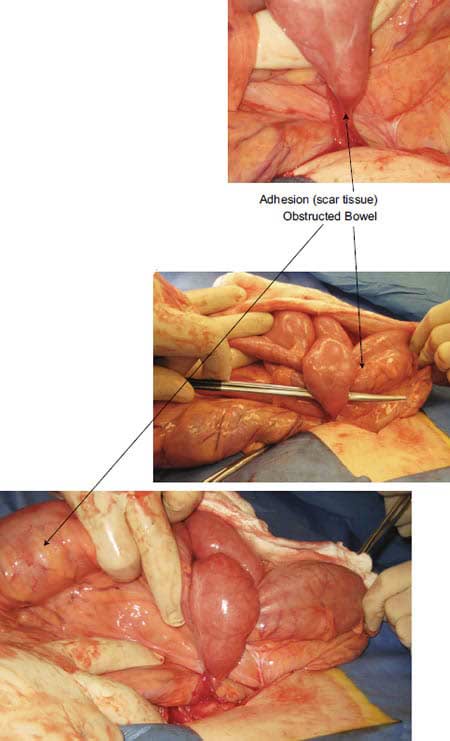
An example of a bowel obstruction caused by scar tissue is noted in the following pictures.
What is Strontium – What are BiphosphonatesExclusive Member Content
September 21, 2009 9:07 pm
Sedentary Lives Can Be Deadly
August 10, 2009 9:42 pm
ScienceDaily— As many as 50 million Americans are living sedentary lives, putting them at increased risk of health problems and even early death, a leading expert in exercise science told the American psychological Association.
Speaking at APA’s 117th Annual Convention, Steven Blair, PED, called Americans’ physical inactivity “the biggest public health problem of the 21st century.”
Blair is a professor of exercise science and epidemiology at the University of South Carolina’s Arnold School of Public Health. He is one of the world’s premier experts on exercise and its health benefits and was the senior scientific editor of the 1996 U.S. Surgeon General’s Report on Physical Activity and Health.
Research has shown approximately 25 percent to 35 percent of American adults are inactive, Blair said, meaning that they have sedentary jobs, no regular physical activity program and are generally inactive around the house or yard. “This amounts to 40 million to 50 million people exposed to the hazard
of inactivity,” Blair said in an interview. “Given that these individuals are doubling their risk of developing numerous health conditions compared with those who are even moderately active and fit, we’re looking at a major public health problem.”
Blair’s extensive research comes primarily from the Aerobics Center Longitudinal Study, in which he found that fitness level was a significant predictor of mortality. The ongoing study began in 1970 and includes more than 80,000 patients.
The researchers periodically measured the participants’ body composition and body mass index, and each patient underwent a stress test. Researchers also looked at numerous other factors including the participants’ medical histories.
One follow-up study of 40,842 longitudinal study participants showed poor fitness level accounted for about 16 percent of all deaths in both men and women.
The percentage was calculated by estimating the number of deaths that would have been avoided if people had spent 30 minutes a day walking.
This percentage was significantly higher than when other risk factors were considered, including obesity, smoking, high cholesterol and diabetes. The
Aerobics Center Longitudinal Study also found that moderately fit men lived six years longer than unfit men.
More examination of 14,811 female patients in the ACLS showed that women who were very fit were 55 percent less likely to die from breast cancer than women who were not in good shape. This was after the researchers had controlled for BMI, smoking, family history of breast cancer and other possible
risk factors.
Blair also highlighted the benefits of exercise on the mind, referring to recent emerging evidence that activity delays the mind’s decline and is good for brain
health overall. Blair said he thinks psychologists can be integral in helping patients understand the health hazards of being inactive and encouraging people to look for more ways to get moving. “Over the past few decades, we have largely engineered the need for physical activity out of the daily lives of most people in industrialized societies,” said Blair.
The message should be simple, he said: Doing something is better than doing nothing, and doing more is better than doing less, at least up to a point. “We need numerous changes to promote more physical activity for all, including public policies, changes in the health care system, promoting activity in educational settings and worksites, and social and physical environmental changes. We need more communities where people feel comfortable walking. I believe psychologists can help develop better lifestyle change interventions
to help people be more active via the Internet and other technological methods.”
My Opinion on Health Care Policy
August 03, 2009 2:47 am
It is nearly impossible to watch television, listen to the radio, read newspaper or surt the net, without having to hear or read about all the expert opinions of what the health care reform is or is not going to do for (to) us.
This debate includes on one end a complete melt down of the delivery system, if the healthcare reform gets approved, and the other end is healthcare for everyone with all the choices with no additional cost! There is also a minority that things everything is great and we should just leave it as is. I am assuming they include the healthcare insurance, pharmaceutical employees, their families and all the lobbyists that they have bought.
I do try to keep in touch with what is going on, and keep my opinion to myself, however I decided to write this piece for the news letter after I received an email (unsolicited) from a hospital co-worker, with a cartoon that summarized what this entire debate is about. Misinformation! Since I am not sure if the image is copyrighted or not I am not going to post it here.
This cartoon depicted a discussion between member of the current administration and public talking about certain aspects of the health care reform. Those of you that know me are aware of my sense of humor, and with that said, I think it is appropriate that the facts are presented with an objective view, when it comes to preservation of human life.
I believe that as a healthcare provider in a community hospital in private practice gives me a unique opportunity to have an informed opinion of the health of our healthcare system. We are in cardiac arrest! Regardless of you being democrat or republican, or any shade of blue, red or any other color, I ask that you all read this as another opinion. I am sure some will agree and some will disagree with parts or all of it. The purpose of this newsletter is not to changes anyones opinion, but rather make sure that the facts are presented accurately from a healthcare providers point of view.
In no particular order I will touch upon some of the issues surrounding this discussion.
1-Rationing of the healthcare. Not a good thing in any case. The reality is that the health care is already rationed. The access to health care is rationed by all insurance companies except Medicare. If a patient is seen in our office, we can not perform any surgery, unless we get an authorization from an insurance company.
If you did not know, I talk to physicians from insurance companies many times a week for this purpose. They, a physician that you have never seen, have not been examined by will decide if the care that I, your treating physician, is recommending is appropriate. It does not sound that bad, until you realize that the insurance physician is for example not even a Bariatric surgeon dictating what type of surgery should and should not be performed. That would be like me taking and advise from a plumber how to wire an electric plug !
2-Deteriorating level of healthcare provided. The average wait in an emergency room has gone up significantly. The number of emergency rooms has gone down also. Both of these mean that in that critical time frame that some of us will need the emergency room care, expert help will be too far (since other ones that were closer closed due to financial strains in 1990’s) and when we get there, we will have to wait because the emergency room will be packed with patients who are there for runny nose, earaches and other problems that should have been addressed by their primary care, had they had one or could pay for it.
3-Tax credit, employee mandate, Insurance subsidy… In one form or another, all this means is who is going to pay for my healthcare. There is no free lunch. Is there any one out there that expects to get healthcare for free anywhere in the world? We pay it in the US in the form of higher operating cost when running a small business, insurance premiums, taxation etc. Each one of us, is paying for our own healthcare directly or indirectly. If you worked for the now bankrupt GM, you may have had healthcare paid for by the company, who passed on that cost thru each car, that we all bought. In the Western Europe, and Canada, the bulk of the funding is collected from taxes and there may not be a mandate for a small business to pay for health insurance. End of the day we are all paying for it one way or another. It is a mute point to play word games with the payment plan. Call it whatever you want, but someone has to pay for it. Can we become more efficient yes we can if we streamline information exchange channels, educate general population, and look at the entire health from a preventive perspective. Our current health care for the most part is a reactive model. On a personal note, I have family members who lives in Europe. They call the national healthcare phone number with concerns. Their needs are meet, surgeries performed, medication provided without any concerns for deductible, copay, authorizations etc. They have an easier access to all level of care than an average family in US. As I indicated above, In my opinion, the healthcare in US is on life support. I am in support of the government option, and regulation of the healthcare insurance industry, with coverage for all especially children. Health care decisions should not be made by an insurance company but the doctor and the patient. I am not in support of government intrusion in our daily life however to set the facts strait the only health insurance model that has the least amount of “medical bureaucracy” is the Medicare model.
If the healthcare reform passes one of two things is going to happen. It will either provide for health care, competitive market, at no additional cost or a complete melt down of the entire system providing an opportunity to build a new functional environment.
Longer Life For Milk Drinkers Lactose Intolerance
July 27, 2009 9:56 pm
ScienceDaily — Research undertaken by the Universities of Reading, Cardiff and Bristol has found that drinking milk can lessen the chances of dying from illnesses such as coronary heart disease (CHD) and stroke by up to 15-20 %.
In recent times milk has often been portrayed by the media as an unhealthy food. The study, led by Professor Peter Elwood (Cardiff University) together with Professor Ian Givens from the University of Reading’s Food Chain and Health Research Theme, aimed to establish whether the health benefits of drinking milk outweigh any dangers that lie in its consumption.
Importantly, this is the first time that disease risk associated with drinking milk has been looked at in relation to the number of deaths which the diseases are responsible for. The review brought together published evidence from 324 studies of milk consumption as predictors of coronary heart disease (CHD), stroke and, diabetes. Data on milk consumption and cancer were based on the recent World Cancer Research Fund report. The outcomes were then ompared with current death rates from these diseases.
Professor Givens explained: “While growth and bone health are of great importance to health and function, it is the effects of milk and dairy consumption on chronic disease that are of the greatest relevance to reduced morbidity and survival. Our review made it possible to assess overall whether increased milk consumption provides a survival advantage or not. We believe it does.
“Our findings clearly show that when the numbers of deaths from CHD, stroke and colo-rectal cancer were taken into account, there is strong evidence of an overall reduction in the risk of dying from these chronic diseases due to milk consumption. We certainly found no evidence that drinking milk might increase the risk of developing any condition, with the exception of prostate cancer. Put
together, there is convincing overall evidence that milk consumption is associated with an increase in survival in Western communities.” The reviewers also believe that increased milk consumption is likely to reduce health care costs substantially due to reduced chronic disease and associated morbidity.
“There is an urgent need to understand the mechanisms involved and for focused studies to confirm the epidemiological evidence since this topic has major implications for the agri-food industry,” added Professor Givens.
- Lactose intolerance is the inability or insufficient ability to digest lactose, a sugar found in milk and milk products.
- Lactose intolerance is caused by a deficiency of the enzyme lactase, which is produced by the cells lining the small intestine.
- Not all people with lactase deficiency have digestive symptoms, but those who do may have lactose intolerance.
- Most people with lactose intolerance can tolerate some amount of lactose in their diet.
- People with lactose intolerance may feel uncomfortable after consuming milk and milk products. Symptoms can include abdominal pain, abdominal bloating, gas, diarrhea, and nausea.
- The symptoms of lactose intolerance can be managed with dietary changes.
- Getting enough calcium and vitamin D is a concern for people with lactose intolerance when the intake of milk and milk products is limited. Many foods can provide the calcium and other nutrients the body needs.
- Talking with a doctor or registered dietitian may be helpful in planning a balanced diet that provides an adequate amount of nutrients—including calcium and vitamin D—and minimizes discomfort. A health professional can determine whether calcium and other dietary supplements are needed.
- Milk and milk products are often added to processed foods. Checking the ingredients on food labels is helpful in finding possible sources of lactose in food products.
What is Osteoporosis
July 06, 2009 8:32 pm
Osteoporosis in epidemic in the U.S. Bariatric patients can be even more prone than the average American. Both RNY/GB and DS patients have issues with calcium absorption. DS patients also have issues with absorption of vitamin D. Both populations must be compliant in supplementation on both. Calcium Citrate is the preferred form as it is far more absorbable than the carbonate form. This is not new news to most of us. Calcium absorption is also greatly enhanced by adequate vitamin D. This is also not new to the average bariatric patient. What is relatively new news is that current information is that some laboratory testing methodology has yielded false high readings in the past leading many to falsely believe their level of supplementation was adequate. In addition to false high level’s in previous lab testing procedures the “normal” ranges have been increased recently. Many now believe 50ng/mL should be looked at as a minimum. My most recent labs came back with the form showing a “normal range” of 5-58ng/mL. Recent publications show that our D levels are vitally important to immune function in fighting any number of conditions from flue (swine flue?) to cancers. I personally am making a concerted effort to raise my D value to at least 50ng/mL before next flue season.
A new and emerging factor in combating the osteoporosis epidemic is the awareness of the importance of vitamin K-2. This is not exactly the same thing as the K we all know. There are two primary forms of vitamin K, K-1 and K-2. Most bariatric supplements, even the very best,supplement only our K-1 levels. K-1 has long been known for it’s involvement in blood clotting. K-2 however is very important for Calcium metabolism. This is relatively new research coming out of Japan.
This vitamin has three very powerful effects on our Calcium metabolism. It minimizes the loss of Calcium in the urine thereby keeping what Calcium that is absorbed “on board” for recycling back into constructive purposes. It stimulates the deposition of Calcium in the bone matrix by increasing the levels of a specific hormone which “turns on” the cells that do this job. K-2 also helps regulate the deposition of Calcium in inappropriate tissues such as the walls of arteries and in ligaments.
Research out of Japan has shown increased bone mineral mass in post menopausal women. A group of women were divided into 4 sub groups. The “control” group (who added nothing to their diet) lost 1% bone mineral mass per year. At the other end of the spectrum a group using Calcium Citrate, D3 and K2 (MK-7) gained 1.5%. The most recent information regarding this very important vitamin has shown that a very specific form of the vitamin is by far the most beneficial. As I noted before this research is coming out of Japan. This form of K-2 was first observed in a traditional Japanese food. Natto is a fermented soy product that is very high in Menaquinone-7 (MK-7). This form is very important. The less advantageous and and more common form MK-4 is less well absorbed and has a “half life” (the time it takes for the blood levels to fall by 1/2) of approximately 90 minutes. The MK-7 is more easily absorbed and has a half life of well over 24 hours.
Caution must be used for patients using “blood thinners”. This vitamin will have a direct effect on their clotting time. Research shows that this can be off set by adjusting the levels of medication. Once these levels are adjusted they tend to be much more stable due to the long half life of the MK-7. One of the side effects of these blood thinners is the loss bone mineral mass. Consult your physician before starting.
Editors Note: It is worthwhile to address a few issues raised in this article by Dr. Caya. The first issue is related to the efficacy of the types of calcium. This issue is addressed extensively in our website and summarized in a table at the FAQ section. The summary of the above table is that, Calcium Citrate is absorbed easier, but more of it needs to be takes to get the same amount of elemental calcium. Less of Calcium Carbonate is needed to get the same amount of elemental calcium, however the absorption is less efficient. A search of the medical literature will provide supporting data for recommending one or another type. I believe that most people at least in the beginning could take either type. The decision of which one to take should be based of which is tolerated better. Later on recommendations for changes will be made.
The other point to remind every one is that this information is not static and continuous to change. It is important the patients stay well informed.
Ara Keshishian, MD