
Strong bones, a healthy immune system, protection against some types of cancer: Recent studies suggest there’s yet another item for the expanding list of Vitamin D benefits. Vitamin D, “the sunshine vitamin,” keeps the heart, the body’s long-distance runner, fit for life’s demands.
University of Michigan pharmacologist Robert U. Simpson, Ph.D., thinks it’s apt to call vitamin D “the heart tranquilizer.” In studies in rats, Simpson and his team report the first concrete evidence that treatment with activated vitamin D can protect against heart failure. Their results appear in the July issue of the Journal of Cardiovascular Pharmacology. In the study, treatments with activated vitamin D prevented heart muscle cells from growing bigger – the condition, called hypertrophy, in which the heart becomes enlarged and overworked in people with heart failure. The treatments prevented heart muscle cells from the over-stimulation and increased contractions associated with the
progression of heart failure.
About 5.3 million Americans have heart failure, a progressive, disabling condition in which the heart becomes enlarged as it is forced to work harder and harder, making it a challenge even to perform normal daily activities. Many people with heart disease or poorly controlled high blood pressure go on to experience a form of heart failure called congestive heart failure, in which the heart’s inability to pump blood around the body causes weakness and fluid build-up in lungs and limbs. Many people with heart failure, who tend to be older, have been found to be deficient in vitamin D.
“Heart failure will progress despite the best medications,” says Simpson, a professor of pharmacology at the U-M Medical School. “We think vitamin D retards that progression and protects the heart.”
The U-M researchers wanted to show whether a form of vitamin D could have beneficial effects on hearts that have developed or are at risk of developing
heart failure. They used a breed of laboratory rats predisposed to develop human-like heart failure. The researchers measured the effects of activated Vitamin D (1,25 dihydroxyvitamin D3, a form called calcitriol) in rats given a normal diet or a high-salt diet, compared to control group rats given either of the same two diets, but no vitamin D treatment. The rats on the high-salt diet were likely to develop heart failure within months.
The rats on the high-salt diet, comparable to the fast food that many humans feast on, quickly revealed the difference vitamin D could make. “From these animals, we have obtained exciting and very important results,” Simpson says.
After 13 weeks, the researchers found that the heart failure-prone rats on the high-salt diet that were given the calcitriol treatment had significantly lower levels of several key indicators of heart failure than the untreated high-salt diet rats in the study. The treated rats had lower heart weight. Also, the left ventricles of the treated rats’ hearts were smaller and their hearts worked less for each beat while blood pressure was maintained, indicating that their heart function did not deteriorate as it did in the untreated rats. Decreased heart weight, meaning that enlargement was not occurring, also showed up in the treated rats fed a normal diet, compared to their untreated counterparts. Simpson and his colleagues have explored vitamin D’s effects on heart muscle and the cardiovascular system for more than 20 years. In 1987, when Simpson showed the link between vitamin D and heart health, the idea seemed far-fetched and research funding was scarce. Now, a number of studies worldwide attest to the vitamin D-heart health link.
The new heart insights add to the growing awareness that widespread vitamin D deficiency—thought to affect one-third to one-half of U.S. adults middle-aged and older—may be putting people at greater risk of many common diseases. Pharmaceutical companies are developing anti-cancer drugs using vitamin D analogs, which are synthetic compounds that produce vitamin D’s effects. There’s also increasing interest in using vitamin D or its analogs to treat autoimmune disorders.
In more than a dozen types of tissues and cells in the body, activated vitamin acts as a powerful hormone, regulating expression of essential genes and rapidly activating already expressed enzymes and proteins. In the heart, Simpson’s team has revealed precisely how activated vitamin D connects with specific vitamin D receptors and produces its calming, protective effects. Those results appeared in the February issue of Endocrinology. Sunlight causes the skin to make activated vitamin D.
People also get vitamin D from certain foods and vitamin D supplements. Taking vitamin D supplements and for many people, getting sun exposure in safe ways, are certainly good options for people who want to keep their hearts healthy. But people with heart failure or at risk of heart failure will likely need a drug made of a compound or analog of vitamin D that will more powerfully produce vitamin D’s effects in the heart if they are to see improvement in their symptoms, Simpson says.
Vitamin D analogs already are on the market for some conditions. One present drawback of these compounds is that they tend to increase blood calcium to undesirable levels. Simpson’s lab is conducting studies of a specific analog which may be less toxic, so efforts to develop a vitamin Dbased drug to treat heart failure are moving a step closer to initial trials in people.
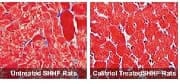
left: Heart muscle cells in untreated rats bred to develop heart failure show signs of disease: Cells are irregular in size and shape and show fibrotic lesions (areas in purple). Right: Heart muscle cells remain healthy in rats treated with calcitriol, the hormone that Vitamin D becomes in the body. (Credit: Image courtesy of University of Michigan Health System)
Exercise for Your Bone Health
Vital at every age for healthy bones, exercise is important for treating and preventing osteoporosis. Not only does exercise improve your bone health, it also increases muscle strength, coordination, and balance, and leads to better overall health.
Why Exercise?
Like muscle, bone is living tissue that responds to exercise by becoming stronger. Young women and men who exercise regularly generally achieve greater peak bone mass (maximum bone density and strength) than those who do not. For most people, bone mass peaks during the third decade of life. After that time, we can begin to lose bone. Women and men older than age 20 can help prevent bone loss with regular exercise. Exercising allows us to maintain muscle strength, coordination, and balance, which in turn help to prevent falls and related fractures. This is especially important for older adults and people who have been diagnosed with osteoporosis.
The Best Bone Building Exercise
The best exercise for your bones is the weight-bearing kind, which forces you to work against gravity. Some examples of weight-bearing exercises include lifting weights, walking, hiking, jogging, climbing stairs, tennis, and dancing. Examples of exercises that are not weight-bearing include swimming and bicycling. While these activities help build and maintain strong muscles and have excellent cardiovascular benefits, they are not the best way to exercise your bones.
Exercise Tips
If you have health problems – such as heart trouble, high blood pressure, diabetes, or obesity – or if you are over age 40, check with your doctor before you begin a regular exercise program. According to the Surgeon General, the optimal goal is at least 30 minutes of physical activity on most days, preferably daily. Listen to your body. When starting an exercise routine, you may have some muscle soreness and discomfort at the beginning, but this should not be painful or last more than 48 hours. If it does, you may be working too hard and need to ease up. STOP exercising if you have any chest pain or discomfort, and see your doctor before your next exercise session.
If you have osteoporosis, ask your doctor which activities are safe for you. If you have low bone mass, experts recommend that you protect your spine by avoiding exercises or activities that flex, bend, or twist it. Furthermore, you should avoid high-impact exercise in order to lower the risk of breaking a bone. You also might want to consult with an exercise specialist to learn the proper progression of activity, how to stretch and strengthen muscles safely, and how to correct poor posture habits. An exercise specialist should have a degree in exercise physiology, physical education, physical therapy, or a similar specialty. Be sure to ask if he or she is familiar with the special needs of people with osteoporosis.
A Complete Osteoporosis Program
Remember, exercise is only one part of an osteoporosis prevention or treatment program. Like a diet rich in calcium and vitamin D, exercise helps strengthen bones at any age. But proper exercise and diet may not be enough to stop bone loss caused by medical conditions, menopause, or lifestyle choices such as tobacco use and excessive alcohol consumption. It is important to speak with your doctor about your bone health. Discuss when you might be a candidate for a bone mineral density test. If you are diagnosed with low bone mass, ask what medications might help keep your
bones strong.
Leave a Reply